
The Devotional Journey: Bible Reading 38
Yahweh’s people need deliverance
Read Exodus 1:1–2:25.
When Adam and Eve sinned, Yahweh had immediately announced a salvation plan (Genesis 3:15). The Bible is the record of God’s unfolding plan and the second book, called Exodus (which means “departure”), continues the account.
Yahweh had told Abraham his descendants would be enslaved in a foreign country for 400 years but He would lead them out at the right time (Genesis 15:12–14). It turned out that Egypt was that foreign country.
After several generations of Egyptian kings, a new Pharaoh who had no appreciation of Joseph had risen to power. He viewed the Israelites (also known as the Hebrews and much later on, the Jews) as a threat. To control them, he began a programme of oppression and genocide.
Step 1: Pharaoh enslaved them to wear them down with harsh labour.
Step 2: He ordered the chief Hebrew midwives to kill newborn Hebrew boys.
Step 3: He ordered Egyptians to drown newborn Hebrew boys.
What Pharaoh didn’t realise was that he was part of the conflict announced in Genesis 3:15, where the people of God would constantly be warring with the “children” of Satan (that is, those influenced by Satan). This conflict still continues today.
Because of this continuing spiritual conflict, the Hebrews have suffered tremendously. But every ruler that has persecuted the Hebrews has been punished because God’s promise to Abraham in Genesis 12:3 is still in force: “I will bless those who bless you and curse those who treat you with contempt.”
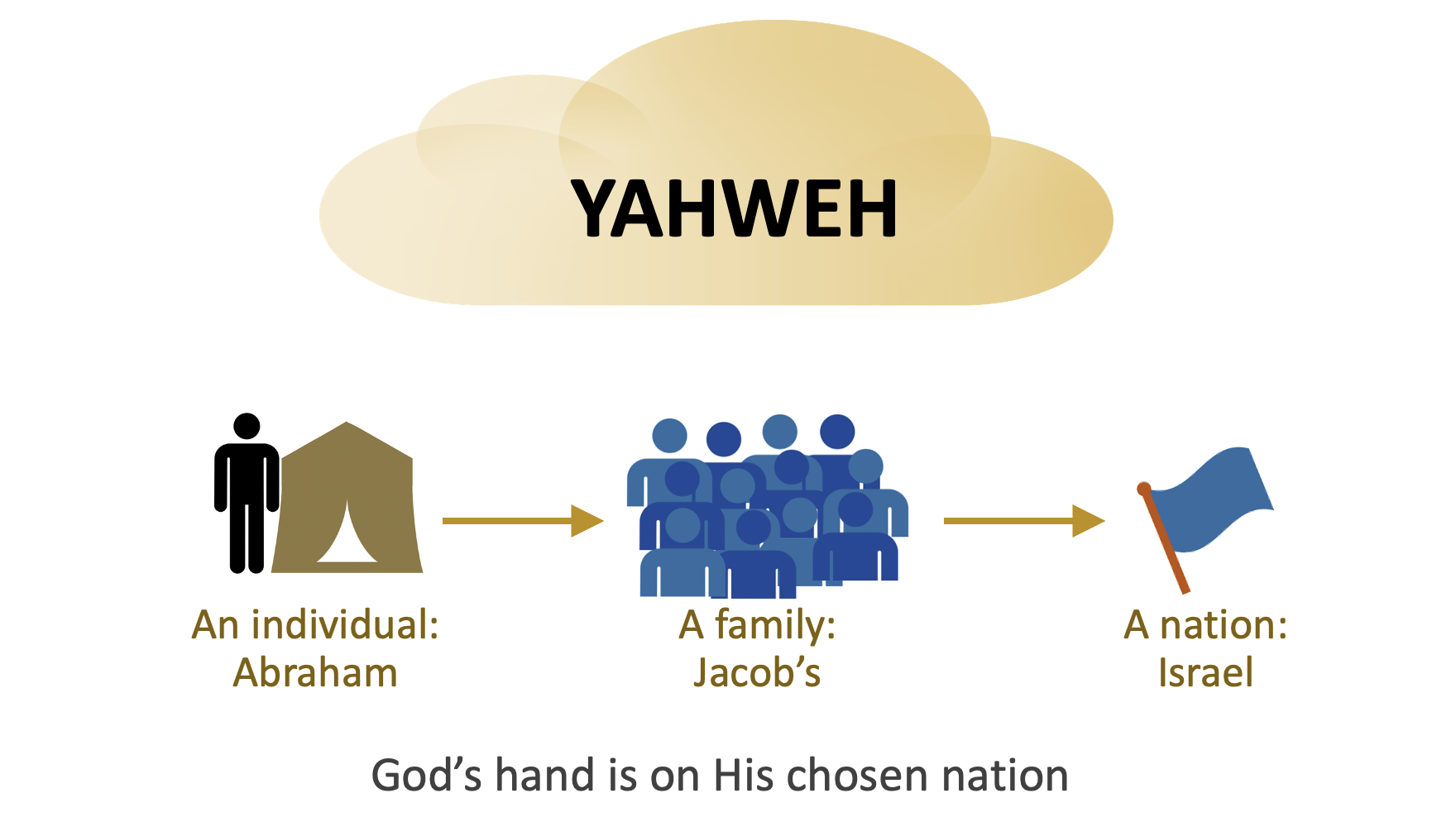
Then the account of Exodus focuses on one couple—Amram and Jochebed, the parents of Moses. (Their names are mentioned in Exodus 6:20.) Moses was the third child after Miriam and Aaron. When he was born, his parents did their best to hide him. But after three months, this became impossible.
So they placed him in the Nile river in a waterproof basket near where Pharaoh’s daughter had come for a ceremonial washing ritual. She heard the crying baby and had him taken out of the water.
Sensing the princess’s willingness to save him, Miriam, who had been hiding nearby, offered to get a wet-nurse to care for the baby. The princess agreed and thus Moses was reunited with his mother who was paid to look after her own baby!
After some years, Jochebed presented her son to the princess who named him Moses. She gave him a royal upbringing (Acts 7:22 mentions this) but since he had spent his early years with his real family, he had learnt about Yahweh and the history of his people.
Then the account jumps to when he was older (Acts 7:23 says he was 40). Moses, as an Egyptian prince, went to see the Hebrew slaves. It must have aroused his sense of injustice to see the Egyptian slave masters treat his people cruelly.
He intervened when he saw an Egyptian beating a Hebrew severely. Though he knew it was wrong, he killed the Egyptian. The next day, he mediated between two arguing Hebrews but they rebuffed him, asking if he was going to kill them like he did the Egyptian. That’s when Moses realised that what he had done was not secret. And indeed, it wasn’t long before Pharaoh ordered his execution and so Moses fled Egypt. He must have been devastated that he couldn’t free his people despite being in a position of authority. But man’s ways are not Yahweh’s ways.
There in the desert region, Moses showed his courage again by intervening in a dispute between the daughters of Reuel and some shepherds at a well for watering livestock. Moses was invited to the home of Reuel. (He was also known as Jethro. See Exodus 3:1.) His family were Midianites, distant relatives of Moses. (Their ancestor Midian was a son of Abraham from Abraham’s second wife Keturah. See Genesis 25:1–2.)
This hospitality eventually led to marriage with one of the daughters, Zipporah, and she bore him a son, Gershom. (Later, she had a second son named Eliezer. See Exodus 18:4.)
Though life seemed to have taken a different turn for Moses, the Bible is letting us know this was Yahweh’s way of preparing His chosen man for the big job ahead. For the next 40 years (see Acts 7:29–30) God had Moses take care of stubborn sheep in the wilderness. This was training to take care of Yahweh's special flock—Israel. Like Joseph’s 17 years as a slave, Moses’ 40 years of work prepared him. God doesn’t just grab hold of a believer and give them a job; rather He takes the time to train them.
Are you feeling like Moses? Perhaps you have a sense that God has plans for you but your life is currently not going anywhere. Perhaps your current life situation is challenging and you see no end to the difficulties.
God has reasons for delays. He hears our groans, sees our plight and feels our pains. But what He has promised, He will perform for He is a promise-keeping God. But things will be done at His timing. And when the right time comes, He will act. In the mean time, we must be like Moses. Even in the “wilderness”, we can learn and grow in our spiritual journey. Let’s not waste the situations we find ourselves in.