
The Devotional Journey: Bible Reading 69
Yahweh organises the work of the Tabernacle for proper worship
Read Numbers 3:1–13, 40–51.
Recall that when the Israelites were still slaves of Pharaoh in Egypt, Yahweh sent 10 judgment plagues to get Pharaoh to release them. The tenth plague was the death of the firstborn males and animals in every household. This tenth plague would affect everyone, both the Egyptians and the Israelites.

However, God told Israel that He would spare the lives of their firstborns if they would sacrifice a lamb and paint the blood on the doorframes of their houses. Everyone in Israel did that and none of their firstborns died.

After that, Yahweh declared that in acknowledging what He did in sparing the lives of their firstborns, all firstborn males and animals would belong to Him. He had saved, or redeemed each one of them from death. So this meant that the firstborn males in each household would now serve God all their lives.
However, recall also that while Israel was at Mount Sinai, while Moses was talking to Yahweh on the mountain, the people created a golden calf idol to worship. When Moses came down the mountain and saw what they did, he commanded all who were loyal to God to take away the lives of those who worshiped the idol (Reading 57).
The Levites showed their loyalty to God by standing on Yahweh’s side and they executed God’s punishment on the idol worshippers.
Because of this, Yahweh rewarded the Levites by choosing their tribe to serve Him instead of all the firstborn males.

In addition, God later also said that one particular Levite family, Aaron (Moses’ brother) and his sons, would serve Him as priests. Aaron was to be the High Priest (or chief priest) and his four sons would serve under him as priests.
Alas, as we had read in an earlier event in Leviticus 10 (Reading 63), Nadab and Abihu were put to death by God for their rebellion against Him. This left Aaron’s other two sons, Eleazer and Ithamar to be the priests.
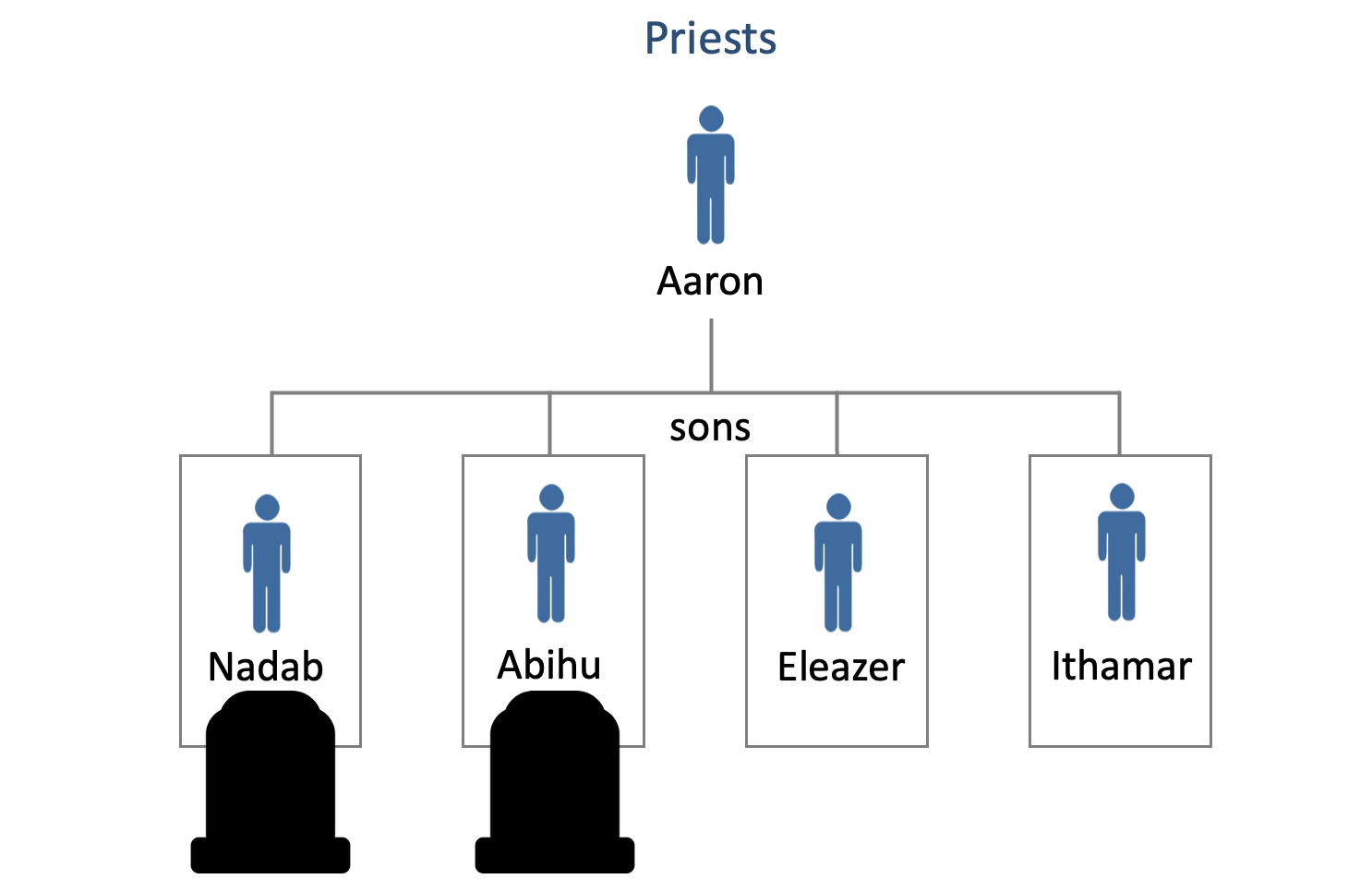
However, it was impossible for just these men to handle all of the work themselves. There was just too much to do. So God chose the entire tribe of Levi to be assistants to Aaron and his sons, by taking on certain responsibilities.
In today’s reading, God was giving instructions to the Levites. They were to do the work needed in the Tabernacle. But they had to be careful not to go too near to the parts of the Tabernacle that only priests were allowed to go.
But Yahweh wanted to ensure that the exchange of firstborn males with the Levites was an equal value exchange. He asked for a count of all the firstborn males in Israel. There were 22,273.
That meant that the tribe of Levi needed to have 22,273 males to replace the firstborns in serving God. But the tribe of Levi only had 22,000 men. There was a shortfall of 273 Levite men.

What could be done? The Levites just could not suddenly come up with 273 more men. So God said He would accept money in exchange for the shortfall. He set the redemption price at five shekels a man.
This meant a total of 273 x 5 =1,365 shekels.

In this way, Yahweh received the full value of all the firstborn males in Israel. He received it through the 22,000 Levite men and the 1,365 shekels.
Why was God doing all this? Why is it helpful for us to know all these details?
Yahweh was preparing the Israelites to engage with enemy nations and defeat them. In making all the arrangements of the people’s roles, detailing the way people were to worship Him and who was responsible for which job, God was showing the importance of organisation. It was important that the camp be orderly. If the camp were not orderly:
the people would experience nothing but chaos and confusion
they would not be worshipping God properly and
they would not be able to fight the enemy successfully.
As we ponder about the character of God, consider if we are like Him in this way.
Do we take the organisation of our lives seriously so we can accomplish the work He wants us to do? Or is our life filled with chaos and confusion? Ask God to help us appreciate His orderly character and also help us order our lives in a way that honours Him, reflects Him and helps us accomplish His will.
Think also about how God gives different jobs and roles to the people: Aaron had certain jobs, the priests had certain jobs, and the Levites had certain jobs. Working together by each doing their work well, the whole camp could run well.
As we think about the different people in our lives and the different roles that they play and jobs that they do, do we treasure and value each one of them for what they contribute? Or are we envious or jealous of their contribution? Let’s talk to God about our attitudes towards our family members, co-workers, project team mates, church friends and others. Let’s ask Him to help us have the right appreciation and attitude towards each of them.