
The Devotional Journey: Bible Reading 82
Yahweh makes a covenant with loyal Phinehas
Read Numbers 25:1–18
This is the final chapter of events surrounding Balaam. He had failed to curse Israel but left the king of Moab with a way to cause Israel to sin: seduce the people to worship false gods.
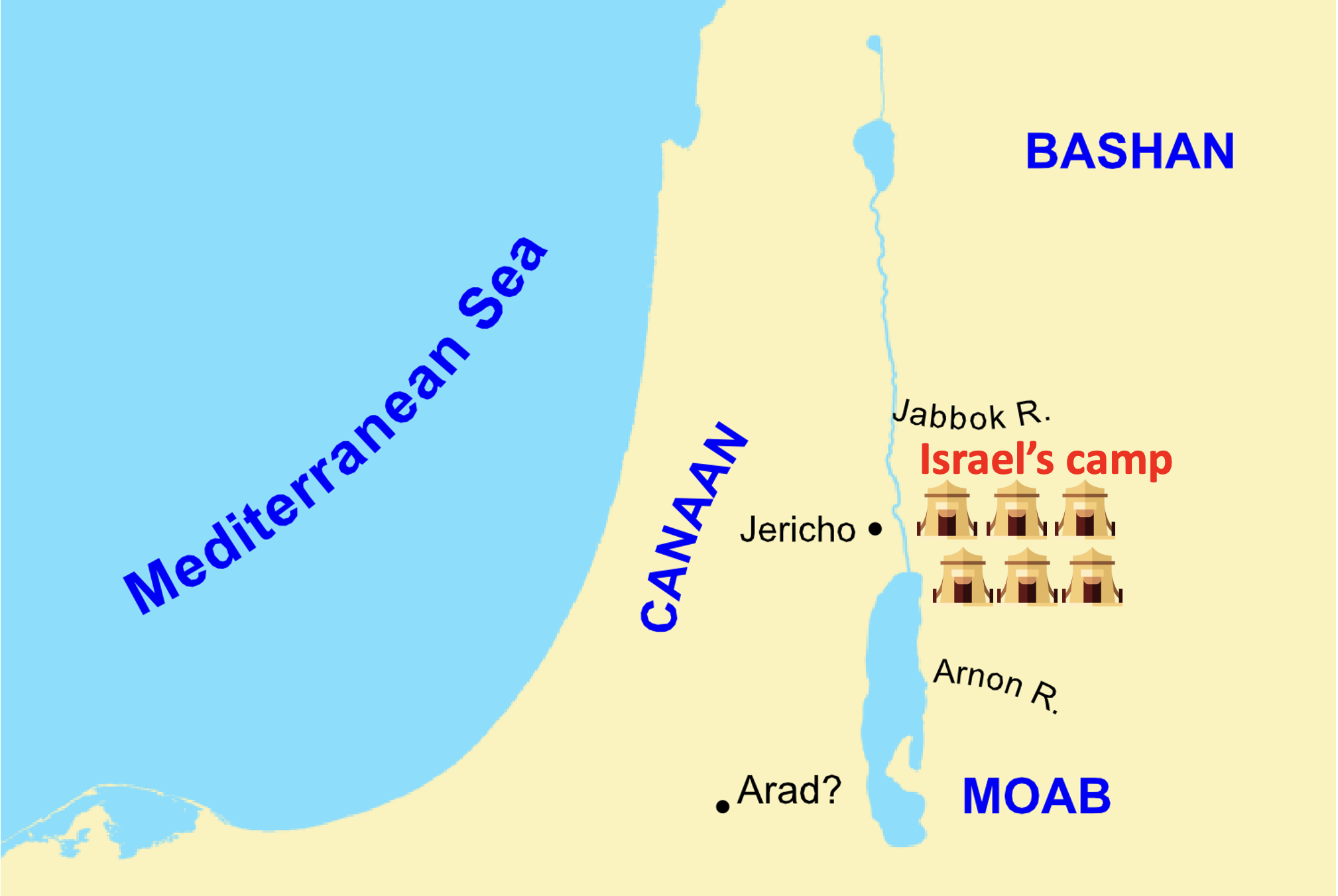
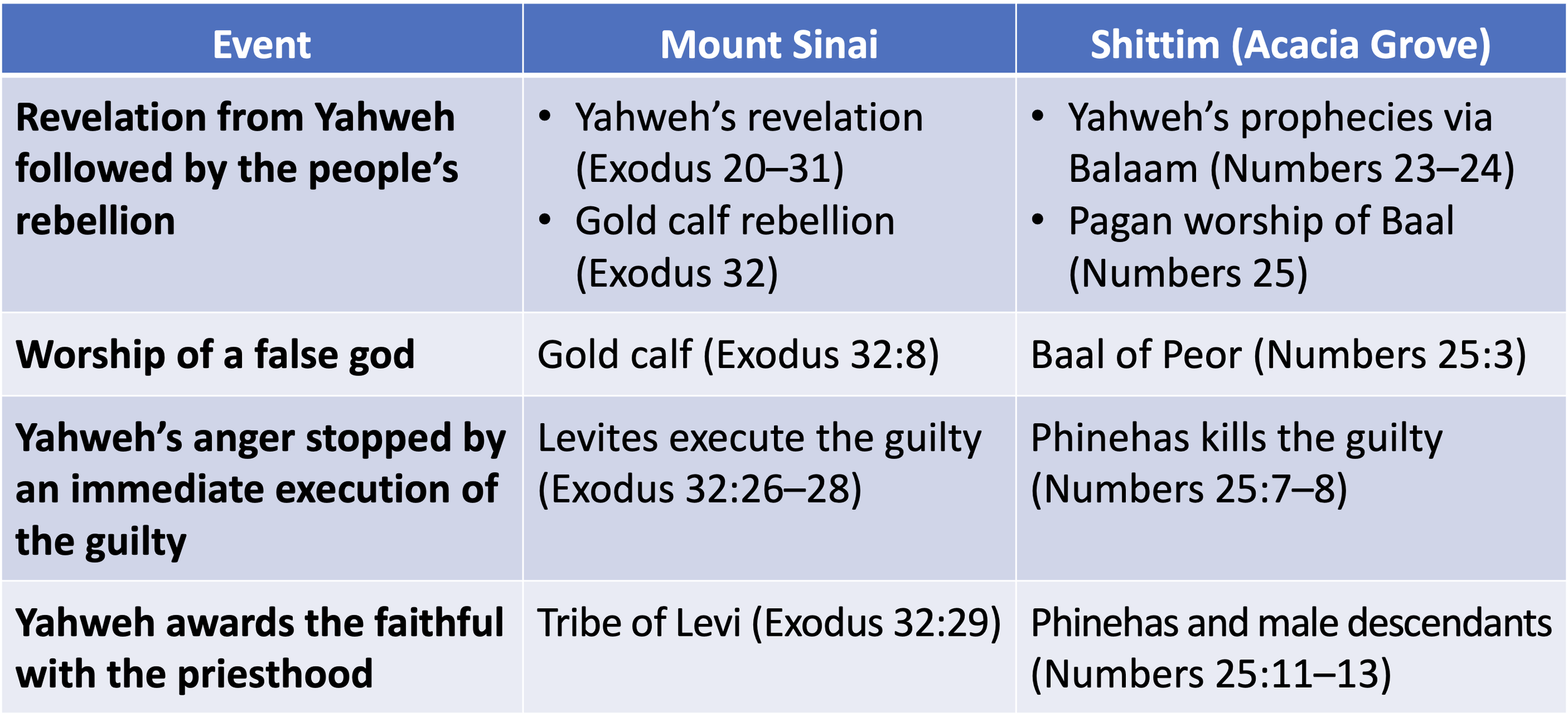
While the Israelites were camped near Moab, at a place called Acacia Grove (Shittim in Hebrew), the Moabites along with their allies, the Midianites, began their plot. They befriended and invited the Israelites to take part in the religious rituals of Baal of Peor, which included cultic sexual practices that supposedly encourage fertility in the land. (At the place called Peor, there was temple dedicated to Baal.)
Many Israelite men participated and Yahweh was swift to punish them with a plague. The Israelites started to die but the sinning did not stop.
God instructed Moses to gather the tribal leaders (also called judges) to execute any Israelite engaging in pagan worship. (Recall that worshipping any other god was violating the Ten Commandments.) During this time in history, hanging a criminal was done by impaling them on a pole.
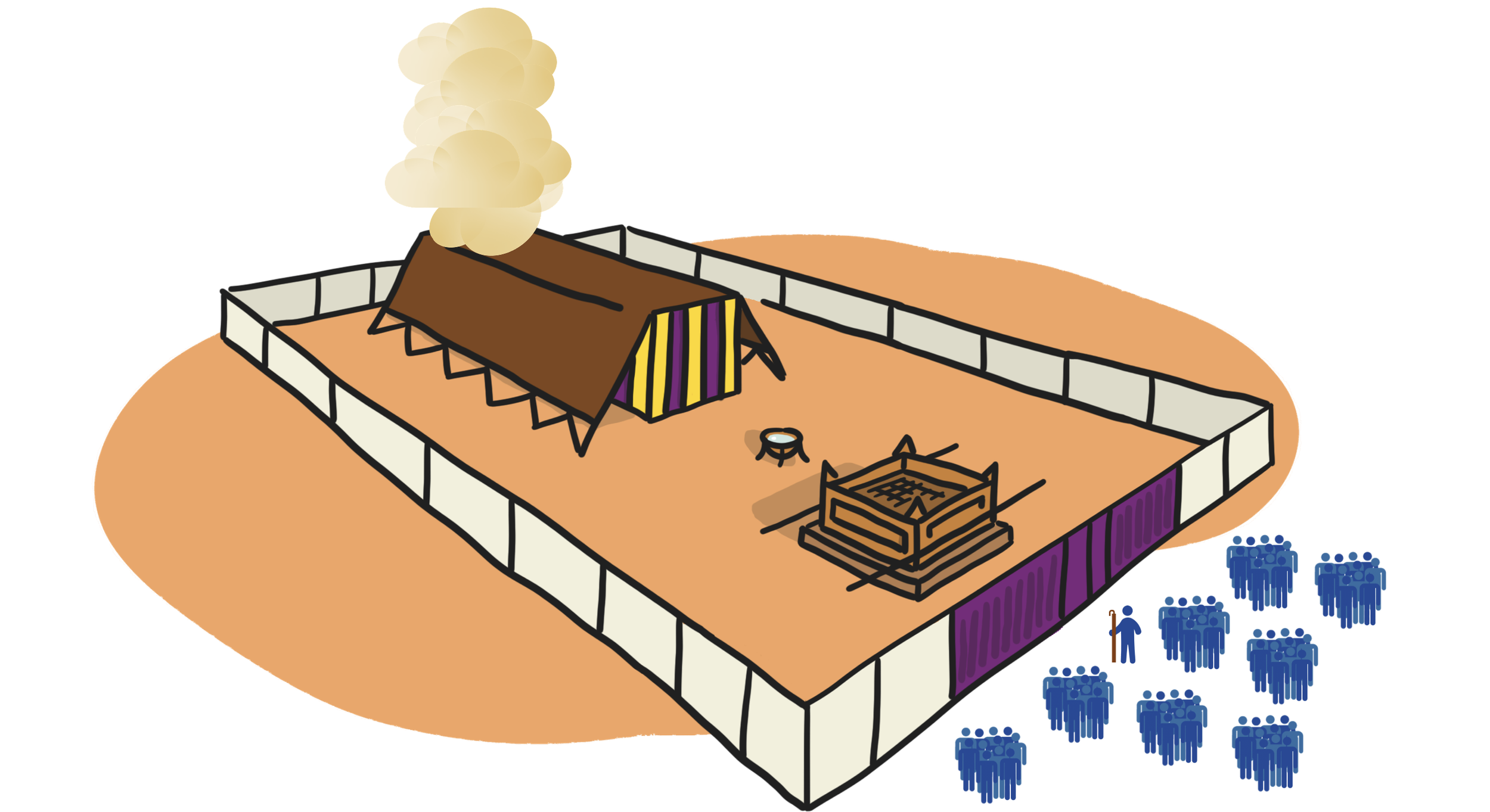
Then Moses, the leaders and others who had gathered at the entrance of the Tabernacle saw an Israelite man take a Midianite woman to his tent. This man was Zimri, the son of Salu, a leader from the clan of Simeon (Numbers 25:14). And the Midianite woman was Cozbi, the daughter of Zur, one of the leaders (or prince) of a Midianite clan (Numbers 24:15, 18). This was sin at the leadership level!
Thankfully, Phinehas, the grandson of Aaron the High Priest, reacted swiftly. With a zeal for God’s honour and holiness, he grabbed a javelin and entered the Zimri’s tent and killed him and the woman with one plunge of the weapon.
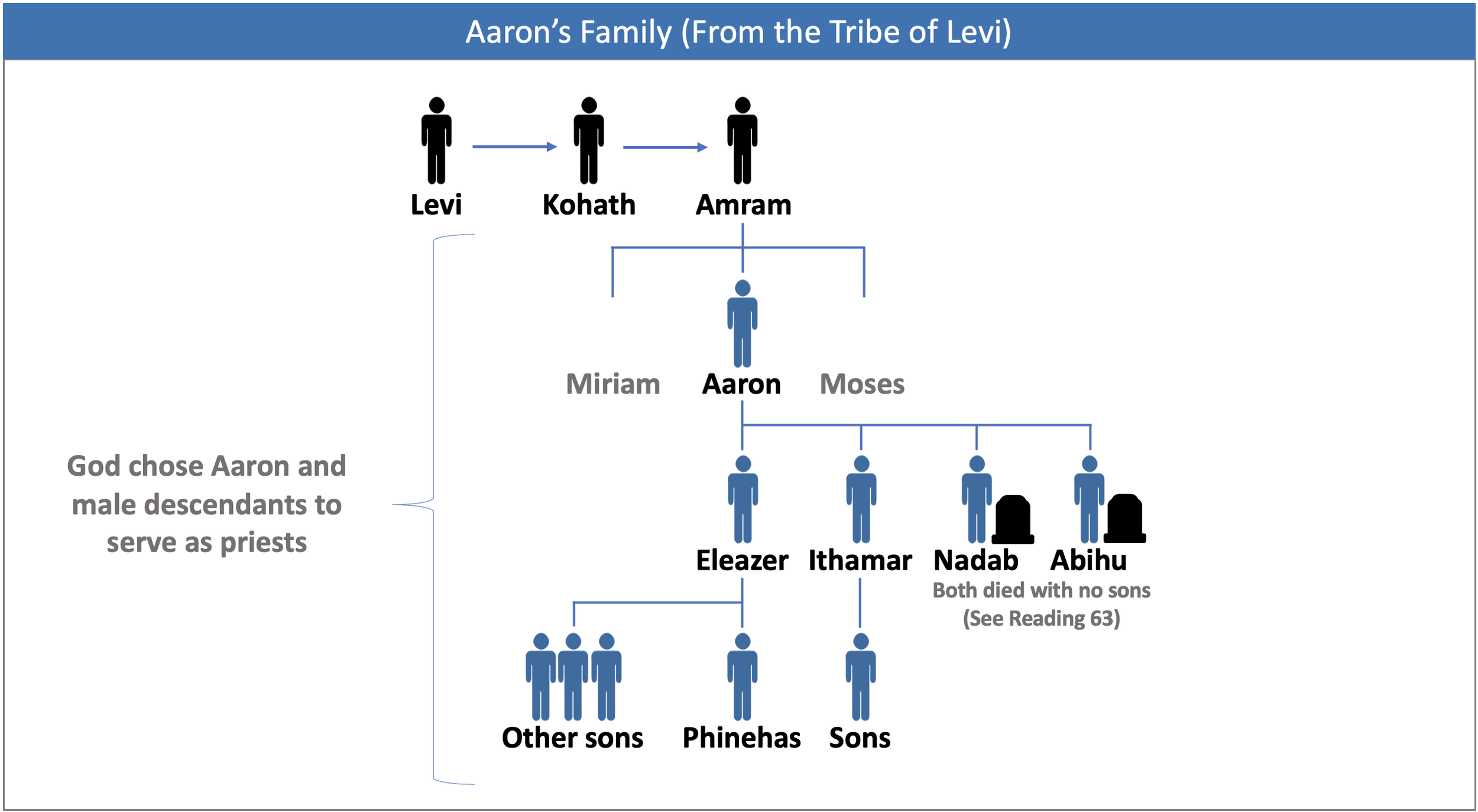
This was following God’s instructions and it stopped the plague. But by then, 24,000 sinning Israelites had already died. This was a sin that had spread throughout Israel.
In response to Phinehas’s actions, Yahweh made a covenant with him. Only he and his descendants would be priests for Yahweh (Numbers 25:10–13). Phinehas was already a priest because he was a descendant of Aaron. But from all of Aaron’s descendants, God was promising that it would only be Phinehas’s family that would continue the priesthood. This is another example of Yahweh making a covenant with an man and his family. (In the future, we will see how God keeps this promise.)
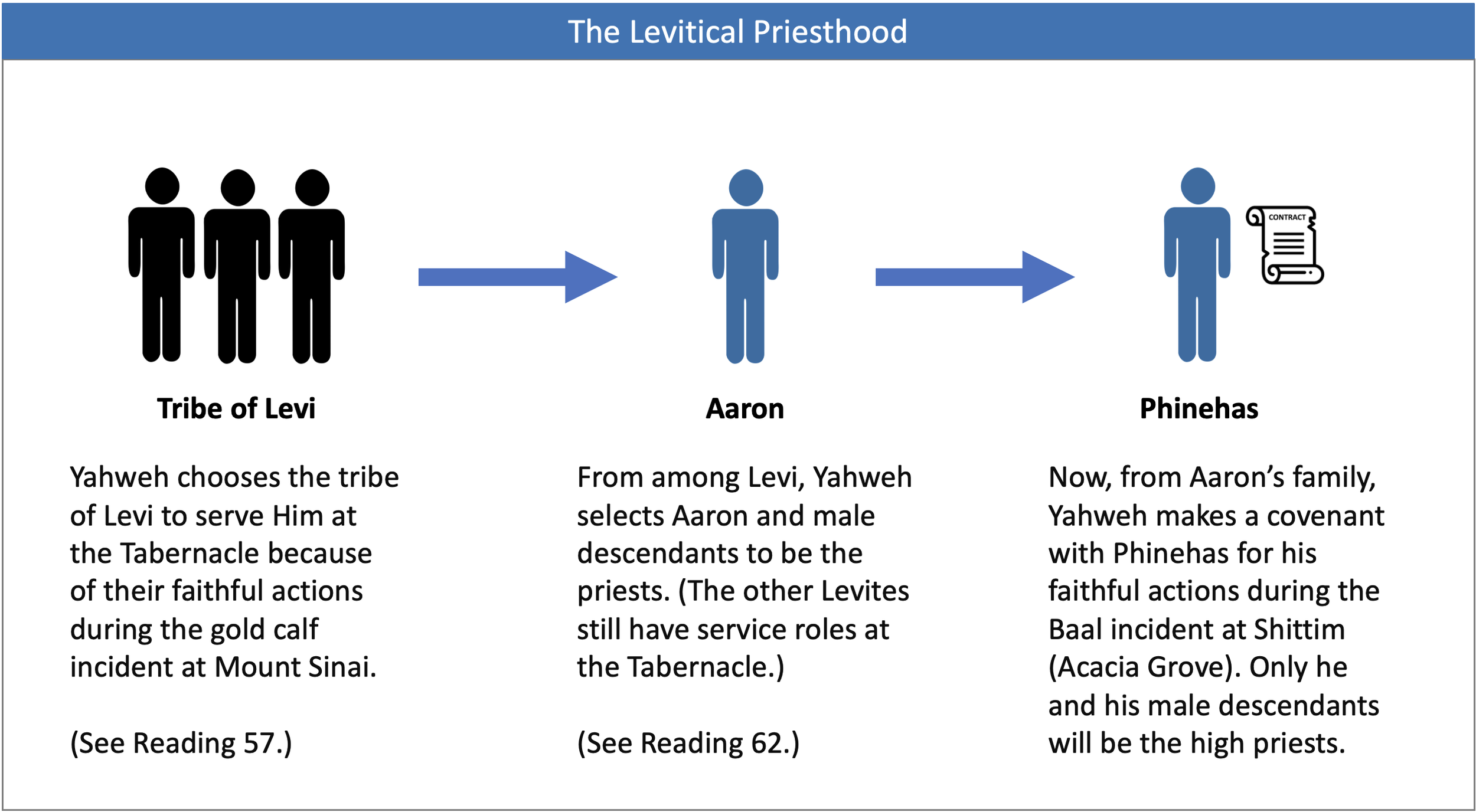
This sinful behaviour of Israel happened near the end of the 40 years of wandering that Yahweh had sentenced Israel to after they refused to enter the Promised Land because of fear (Reading 74). This incident was a lesson for the second generation of Israel, similar to what their parents faced with the gold calf incident at Mount Sinai (Reading 57).
Later, we see the psalmist and the prophet Hosea recall this shameful incident.
Psalm 106:28
Then our ancestors joined in the worship of Baal at Peor;
they even ate sacrifices offered to the dead!Hosea 9:10
The LORD says, “O Israel, when I first found you,
it was like finding fresh grapes in the desert.
When I saw your ancestors,
it was like seeing the first ripe figs of the season.
But then they deserted me for Baal-peor,
giving themselves to that shameful idol.
Soon they became vile,
as vile as the god they worshiped.
Questions for reflection
First: The Israelite men probably didn’t start out wanting to worship idols. But they were enticed by the offer of feasting and then sexual relations with the Midianite women. One thing led to another and they ended up worshipping Baal. This is a sobering lesson for us. When we as disciples of Christ relax our standards just to enjoy ourselves or satisfy our desires, it can be a slippery slope leading us away from the Lord faster than we expect. Let’s examine ourselves. Have we relaxed our standards or our guard in some areas of our life: finances, inappropriate relationships, habits or activities?
Second: Phinehas had a swift reaction to the Zimri’s sin with Cozbi, the Midianite princess. His reaction was based on zeal for God’s holiness and that God had ordered capital punishment for the ones worshipping Baal. While we always need to watch when we react in anger or zeal, Phinehas’s example does set down some principles to think through when we get angry.
Ask yourself:
Why am I angry?
Whose rights are being violated? Mine or someone else’s?
Is God’s truth or principle being violated?
If it’s only our rights being violated, it may be wise to keep our emotions under control and not exert ourselves.
If we are reacting because someone else is being abused or taken advantage of, then we need to think how we can help.
If God’s truth is at stake, we need to think how we can stand up for God without being disagreeable.
These situations may be tricky to handle, but the more we know God and His Word, the wiser we will become about how to handle them. Pray for the Holy Spirit’s guidance before we react out of our emotions.
The Devotional Journey: Bible Reading 81
Yahweh delivers prophecies through Balaam
Read Numbers 22:41–24:25.
Continuing from Reading 80, Balaam instructed King Balak of Moab to offer sacrifices to Yahweh (instead of his usual false gods). Balaam was hoping to appease Yahweh and be allowed to curse Israel. But God cannot be bribed. Instead, Yahweh spoke through the evil prophet to deliver four prophecies or oracles.

First prophecy (Numbers 23:7–10)
This one summarised the events leading up to the present moment. Balaam echoed the blessings Yahweh had given Abraham about having descendants as numerous as the dust of the earth (Genesis 13:16, 22:17, 28:14).

Second prophecy (Numbers 23:18–24)
Yahweh gave Balaam truth about Himself.
Yahweh is not like man. He doesn’t lie.
Yahweh doesn’t change His mind.
His character is unchanging (immutable) so His words can be trusted.
Once He makes a promise or decides on a course of action, He won’t go back on His word.
Yahweh’s unchanging character is important for us to appreciate. His promises and prophecies will be completely and precisely fulfilled. We can stake our lives on His word.

Third prophecy (Numbers 24:2–9)
The Holy Spirit directed Balaam to describe Israel’s land (which God gave them) to be like the garden the Eden. He also mentioned “Agag”, most likely the title of a king, like how “Pharaoh” is the title of Egypt’s king. Later, Israel’s first king, Saul, would defeat a king named “Agag” (1 Samuel 15:7–9, 32–33).
Significantly, Balaam uttered one key promise of the Abrahamic Covenant (Genesis 12:3).
Numbers 24:9a
Blessed is everyone who blesses you, O Israel,
and cursed is everyone who curses you.”
God was affirming He would continue to protect Israel and bless or curse others depending on how they treated Israel. In the same way, we can be reassured God will never break His promises to us—like eternal life with Him, the Holy Spirit’s presence with us and more.

Fourth Prophecy (Numbers 24:15–24)
This final one includes four smaller oracles directed at Moab and other enemy nations. King Balak, who sought to curse Israel, would be cursed instead, along with his nation.
Balaam also said:
Numbers 24:17a
I see him, but not here and now.
I perceive him, but far in the distant future.
A star will rise from Jacob;
a scepter will emerge from Israel.

Balaam saw an individual who would come from Israel in the distant future. He would be a ruler (a star) holding a sceptre (the symbol of a king’s power and authority.) Balaam was seeing the future Messiah, that is, Jesus.
These details were also what Jacob had said when he spoke prophetically over his twelve sons at the end of his life.
Genesis 49:10
The scepter will not depart from Judah,
nor the ruler’s staff from his descendants,
until the coming of the one to whom it belongs,
the one whom all nations will honor.
Yahweh was affirming His plan to send a Messiah who would be the ultimate ruler, not just of Israel, but the world. And the Messiah would fulfil the promise of Genesis 3:15 of destroying Satan.
After this, Balaam left. Since he hadn’t done what Balak wanted, the king didn’t pay him.
But Balaam’s account didn’t end there.
He left the king of Moab with some evil advice: “You can’t defeat Israel, but you can seduce them.”
Yahweh had warned Israel not to mingle with the pagan nations but Israel disobeyed. While Balaam couldn’t curse Israel, his evil advice succeeded. When invited, some of the Israelites joined the Moabites in worshipping false gods and participating in cult prostitution (the practice of engaging in sexual relations to encourage the idols to bless the land with fertility).
Here’s what happened in the next chapter.
Numbers 25:1–3
[1] While the Israelites were camped at Acacia Grove, some of the men defiled themselves by having sexual relations with local Moabite women. [2] These women invited them to attend sacrifices to their gods, so the Israelites feasted with them and worshiped the gods of Moab. [3] In this way, Israel joined in the worship of Baal of Peor, causing the LORD’s anger to blaze against his people.
Jesus speaks about this incident in Revelation, the last book:
Revelation 2:14
“But I have a few complaints against you. You tolerate some among you whose teaching is like that of Balaam, who showed Balak how to trip up the people of Israel. He taught them to sin by eating food offered to idols and by committing sexual sin.
And Moses also said this to Israel’s military commanders after they had battled Midian (an ally of Moab):
Numbers 31:15–16
[15] “Why have you let all the women live?” he demanded. [16] “These are the very ones who followed Balaam’s advice and caused the people of Israel to rebel against the LORD at Mount Peor. They are the ones who caused the plague to strike the LORD’s people.
Eventually, Balaam was killed by Israel’s forces.
Joshua 13:22
The Israelites had also killed Balaam son of Beor, who used magic to tell the future.
Questions for reflection
Do we do something similar to Balaam with his many sacrifices when we attempt to give something to God (an extra offering, volunteering for a church project, or more time in devotions) in hopes that He’ll give us what we want? God cannot be manipulated. He’s our Father and we can go to Him with what’s on our mind. But we need to be humble and recognise that He knows what’s best for us. It’s good for us to know His will for our lives and then to pray for His help that His will be done. And how can we know His will for us? Much of it is already in His Word. What Jesus taught His disciples to do is also meant for us. We can start there.
Balak brought Balaam to different locations, hoping the change of scene would help. Like many pagans of that time, Balak thought that gods only had certain areas of influence. Perhaps he was trying to move out of Yahweh’s area of power. What about us? When we face life challenges, do we try to escape by having a change of scene? Do we change jobs, move home or even move cities? If the problem is rooted in us or in our wrong understanding about God, a change of location isn’t going to solve the problem. Instead, be humble, and ask God to deal with our inner motives. Then ask for the Holy Spirit to reorient our motives and attitudes, and ask for strength to move forward in obedience.
Though God warned Balaam against cursing Israel, he kept trying because of his desire for money. (Read 2 Peter 2:14–16 and Jude 1:11 where the Bible compares people who are greedy with Balaam.) What about us? Is gaining wealth a priority? God knows we need financial resources, but is that all we are focused on, to the point where we spend most of our time and energy on gaining more? Do we push back on what God wants us to do because we tell ourselves we first need to be financially secure? If money matters are distracting you, have a conversation with God about them.
God interacted with Balaam but he continued to follow his evil desires. What about us? God has certainly interacted with each of us through His Word, His Holy Spirit and through His providential actions in our lives. Have we yielded our hearts to Him? Or are we still motivated by our own desires? Balaam was eventually killed by the Israelites. It would be grievous for us if God had to discipline us because we refuse to listen.
The Devotional Journey: Bible Reading 80
Yahweh blocks Balaam and his donkey
Read Numbers 22:1–41.
After the defeat of Arad, Sihon of the Amorites and Og of Bashan, and after being punished with poisonous snakes, the Israelites finally arrived on the east side of the Jordan River, across from the Canaanite city of Jericho.
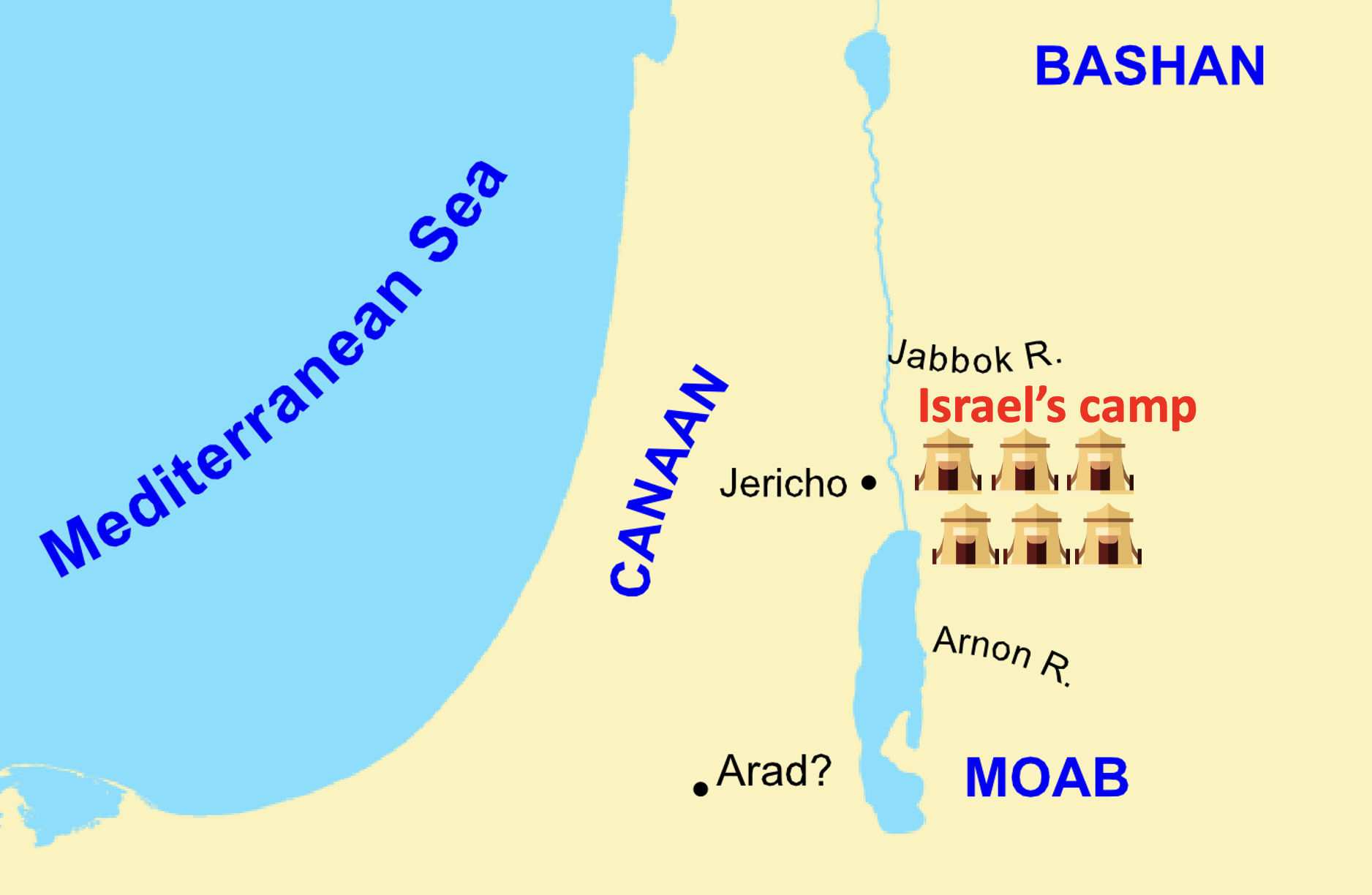
Israel camped just north of Moab and this worried Balak, one of the Moabite kings. He feared Israel but didn’t know they had no intention of attacking Moab. He did two things to protect his nation: He made an alliance with the Midianites and he tried to hired a diviner, Balaam son of Beor, to curse Israel.
Balaam claimed to be able to tell the future and to bless or curse nations. Moses recorded the rather comical events that brought Balaam to King Balak.
As a so-called diviner, Balaam’s profession was something that Yahweh condemned. For example, God commanded Israel:
Leviticus 19:26, 31
[26] “Do not eat meat that has not been drained of its blood.
“Do not practice fortune-telling or witchcraft.
[31] “Do not defile yourselves by turning to mediums or to those who consult the spirits of the dead. I am the LORD your God.
God forbade divination because it engaged with demonic forces. And God wanted His people to rely on Him, the One who is in control of all events, including the future.
Though Balaam practised divination, he actually knew Yahweh and called Him by name. Notice how Balaam used the name Yahweh (spelt as “LORD”) in verse 8 (and verses 13, 18, 19). But he didn’t acknowledge Yahweh as the one and only true God and his heart was self-centred.
When Balak’s envoys arrived, Balaam knew it was wrong to curse Yahweh’s chosen people but he told the envoys he would ask Yahweh. God warned him not to go with Balak’s men. Balaam initially obeyed, but when Balak offered more money, Balaam became greedy and bargained with Yahweh, although he already knew Yahweh’s answer.
And this is where we see another example of Yahweh dealing with people’s evil desires. Recall how Israel had whined about lacking meat. Yahweh’s response was to let them have what they wanted and He covered them in quail (Reading 72)! God’s punishments were to sometimes let people have their evil desires. And so it was with Balaam. Though God was angry with Balaam’s greed, He allowed the diviner to go with Balak’s men. But He warned Balaam to speak only the words that God would give him.

Along the journey, Yahweh mocked Balaam by making his donkey talk. This animal was known for being stupid and stubborn (much like Balaam’s behaviour!). As a diviner, Balaam was supposed to be able to see the future, but God allowed the donkey to see Him first. The “Angel of the LORD” is a title referring to an appearance of God Himself.
Yahweh was acting to keep His promise to Abraham.
Genesis 12:3
I will bless those who bless you and curse those who treat you with contempt. All the families on earth will be blessed through you.”
He would bless those who blessed Abraham and his descendants, but curse those who cursed Abraham. God was actively protecting Israel, Abraham’s descendants, by warning Balaam not to curse Israel.
When Balaam realised that it was impossible for him to curse Yahweh’s people, he ended up speaking blessings and prophecies as the Holy Spirit gave Him the words (Numbers 23–24). We’ll examine what he said in the next reading.
Questions for Reflection
There is much we can learn from Balaam’s bad example. Here are some thoughts and questions for us.
On the outside, Balaam looked spiritual. He talked to God! But in his inner life, he was driven by greed and idolatry. What about us? Do we acknowledge Yahweh as God but aren’t willing to submit to Him? Do we try to appear pious? Could the effort we put into appearing pious be better used in dealing with our poor motives and the sin in our lives?
Balaam already knew God didn’t want him speaking against Israel. Yet he went back to ask God about going with Balak’s men, hoping God would change His mind. When we go to God in prayer, do we seek His will for our lives, or do we ask only for what we want, or ask Him to bless our plans, or ask Him to let us have our way? Are we actually interested in what God has in mind for us?
Talk to God about your desires and motivations. Ask God to highlight areas in your life that need to change and be willing to submit all areas of your life to God. After all, He knows our future.
Archaeological Note
In 1967, archaeologists found a non-Hebrew temple in Deir ‘Alla (in modern-day Jordan). Dated between 840 and 760 BC, the collapsed plaster walls left a pile of plaster pieces on the ground. When the pieces were fitted together like a jigsaw puzzle, Aramaic words emerged. This was believed to be the oldest example of Aramaic writing and the inscription was dedicated to the “seer of the gods, Balaam, son of Beor.”

Photo of the Deir ‘All inscription. From Meyer, Tom. Archaeology And The Bible: 50 Fascinating Finds That Bring The Bible to Life. Lamplight Press, an imprint of ICR Publishing Group, 2023.
This temple linked to Balaam continued to function until the building was destroyed by an earthquake around the eighth century BC. In the inscription, Balaam cursed the gods who brought famine and death and he sought help from the fertility gods who could restore life and order to the region. The temple seemed to function as some kind of diviner school which could explain why Balaam continued to be revered for hundreds of years after his death.
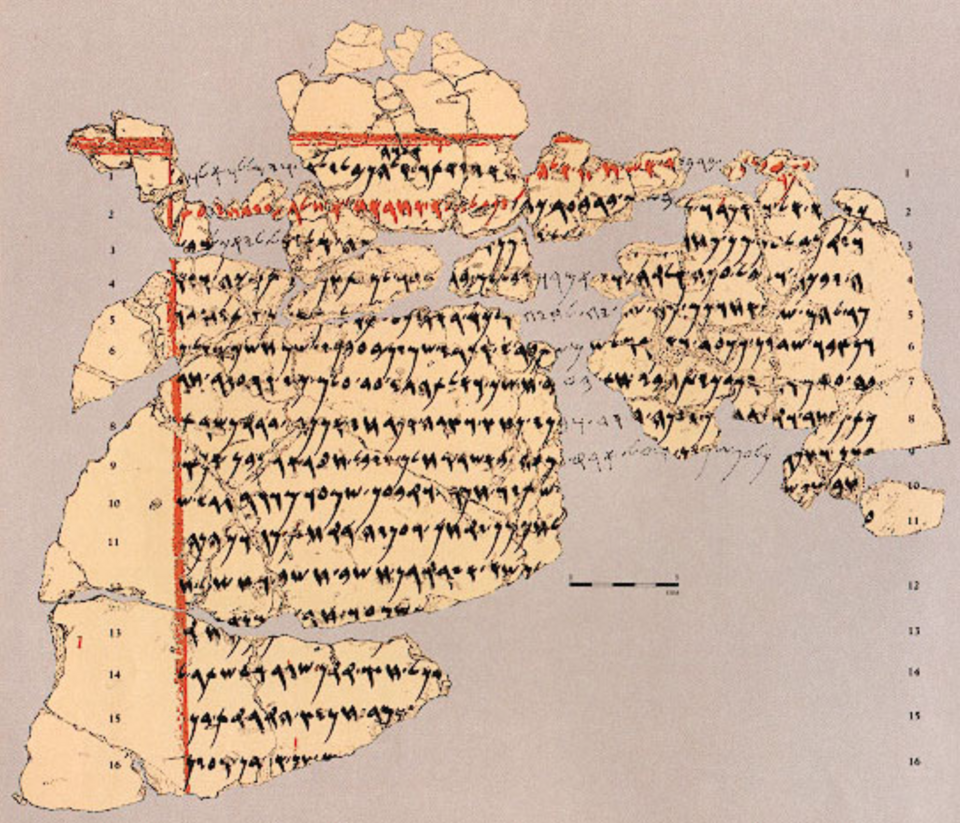
Drawing of the Deir ‘Alla inscription. By Disdero - Own work, CC BY-SA 4.0, Wikimedia Commons.
This Balaam inscription is another example of an archaeological find that affirms the details, accuracy and truthfulness of the Bible.
The Devotional Journey: Bible Reading 79
Remember Yahweh’s faithfulness
Read Psalm 78.
This psalm was written later in history by Asaph, one of King David’s three chief musicians (1 Chronicles 15:16–17). It emphasised the importance of passing on to the next generation Yahweh’s record of mighty works. Asaph also urged his generation to keep the Mosaic Covenant that Yahweh had made with Israel.
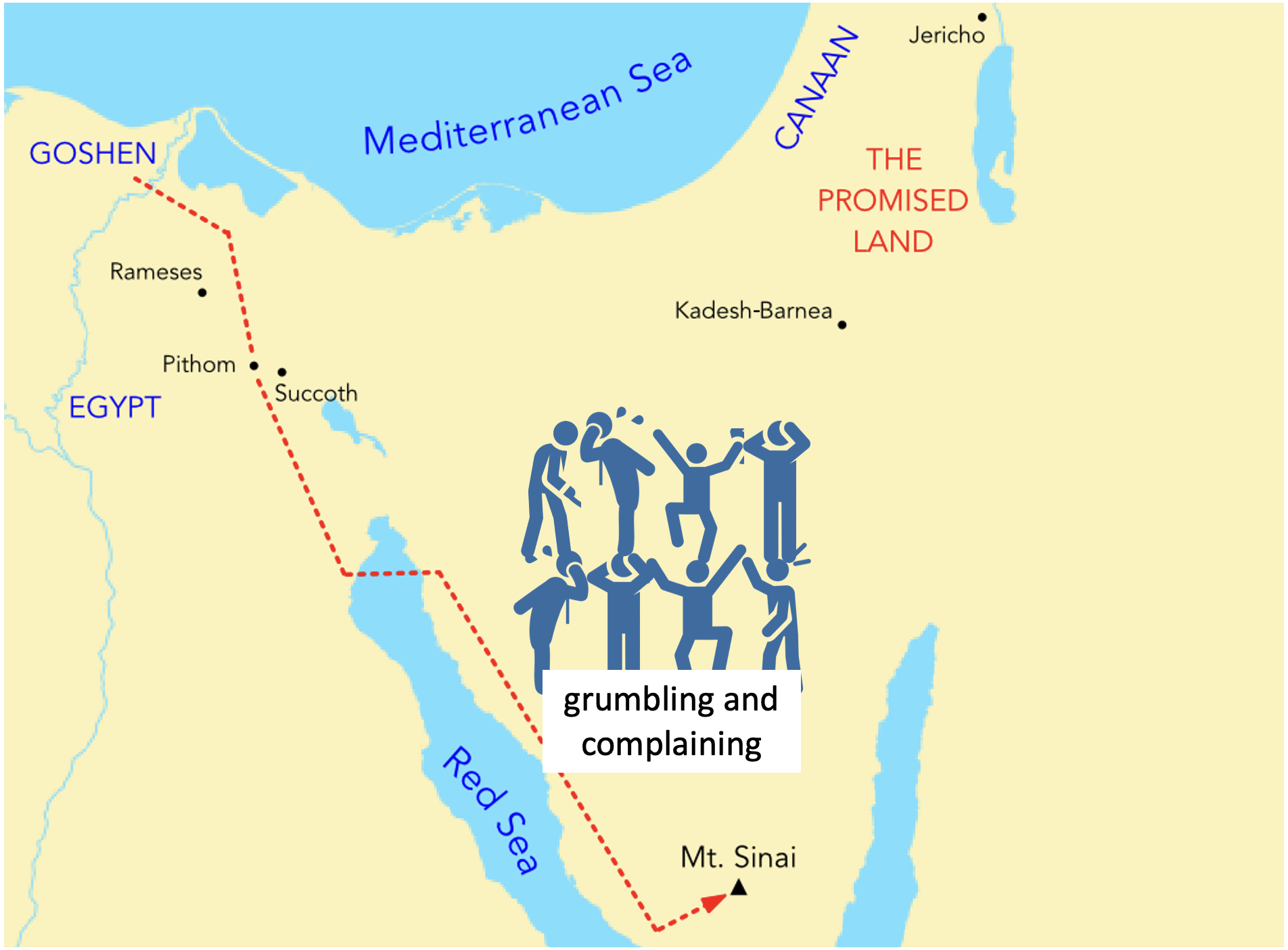
Asaph warned about the dangers of forgetting God’s works. He wrote about the earlier generations who had rebelled, including the Exodus generation who was punished in the wilderness. (This generation will be our focus since we’re still going through their history. We’ll look at the other generations in future readings.)
In the last few readings, we’ve seen Israel complain, rebel and be stubborn. Asaph listed the reasons why.
The spirits or hearts of the people were not faithful to Yahweh (verse 8).
They refused to obey God’s law (verse 10).
They forgot the mighty works God had done for them (verses 11–12).
They foolishly tested the limits of God’s patience (verse 18).
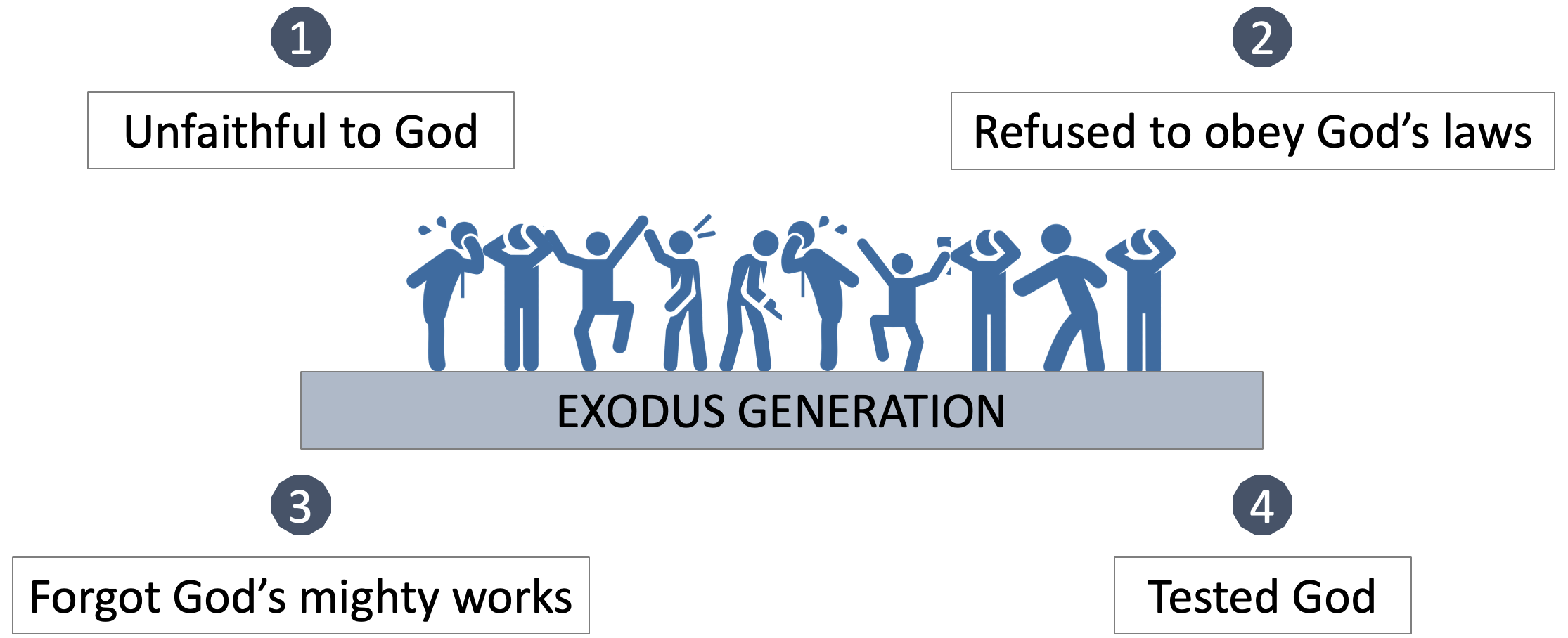
The people were not faithful to Yahweh (Verses 4–8)
Why were the people unfaithful? It started when they weren’t grateful for what God had done. Then they forgot His acts and this lead to being unfaithful.
The people refused to obey God’s law (Verse 10)
Individuals, families and the society will thrive when each person lives by God’s law. That was how Israel was supposed to function. But instead, the people refused to live by His laws. They thought they knew better and rebelled. The consequences were serious. God punished the nation again and again.
The people forgot what God had done for them (Verses 11–12)
Yahweh demonstrated His power against the false gods of Egypt. He miraculously rescued them from their slave masters. In the wilderness, He provided food and water for 38 years. He protected them from enemy nations. But the people forgot all of this. They not only rebelled, they invented their own gods, gave credit to these idols and turned their backs on Yahweh.
God rightfully punished them. For their disobedience, He could’ve wiped them out completely. Several times He threatened to do just that. But He also exercised mercy and refrained from destroying Israel. He punished them to show how He had standards and how He would get rid of evil permanently one day, but He also showed mercy by sparing the nation from utter destruction.
Even in discipline, God was teaching Israel His character: He is a God who is merciful but He will by no means excuse the guilty (Exodus 34:7).
Psalm 103:8–10
[8] The LORD is compassionate and merciful,
slow to get angry and filled with unfailing love.
[9] He will not constantly accuse us,
nor remain angry forever.
[10] He does not punish us for all our sins;
he does not deal harshly with us, as we deserve.
The people foolishly tested God’s patience (Verses 17–20)
The Israelites in the wilderness provoked God by acting as if He were uncaring, incapable or evil. God punished them for this poor attitude.
In the New Testament, the apostle Paul warns us not to be like this Exodus generation.
1 Corinthians 10:9–11
[9] Nor should we put Christ to the test, as some of them did and then died from snakebites. [10] And don’t grumble as some of them did, and then were destroyed by the angel of death. [11] These things happened to them as examples for us. They were written down to warn us who live at the end of the age.
This is why it’s important to read all of Scripture. God has spiritual lessons from history to teach us.
Let’s reflect on our lives and attitudes towards God. Our complaining often has its roots in one of these four causes.
Have we been faithful to God?
In our daily lives, do we live in a way that honours God, keeps His commands to love Him and our neighbour as ourselves (Matthew 22:37–40)? Do we conscientiously teach our children, loved ones and family members about God so they can also learn to love Him and be faithful to Him (verses 1–7)? If not, how can we reorder our lives so we can be personally faithful and also teach our family about God? Talk to God about how to reorder your life.
Have we obeyed God’s Word in every area of our lives?
God wants us to thrive in our family relationships, at school, at work and the other areas of our lives. Are we floundering or facing difficulties? Bring these areas to God in prayer and ask Him to reveal where you haven’t applied His Word.

Have we been regularly recalling God’s character by refreshing our minds through the reading of His Word?
Have we also reviewed how God has taken care of us? When our memory of God’s character and actions fade, our gratefulness also fades. Be determined to change this by returning to a daily habit of reading the Bible carefully and also keeping notes (perhaps in a journal) of how God has acted in our lives. A thankful heart leads to a humble, grateful attitude towards God.

Have we been testing God?
Have we even thinking that God is small, petty or mean-spirited? Do we think He’s been a poor provider or withholding blessings we deserve? Talk to God about this. Remember that though He loves to lavish His children with blessings, He does have standards for His people and He uses trials to grow us. How have we been acting? Have we been faithful?
When complaints against God rise up in our minds or to our lips, let’s quickly stop ourselves and prayerfully look for the root cause and dig it out from our lives.
The Devotional Journey: Bible Reading 78
Yahweh punishes the people with poisonous snakes
Read Numbers 21:1–35.
The Israelites were now on the march towards the Promised Land. They departed from Mount Hor where Aaron was buried (Numbers 20:23–24) towards the plains of Moab (Numbers 22:1). This chapter contains three early battles that showed Yahweh’s protective guidance of the nation despite all their faults and failures.
God directed Israel southeast skirting past Edom, then northwards. Though the general direction is clear, the exact route is not known with precision because several locations have been hard to identify.
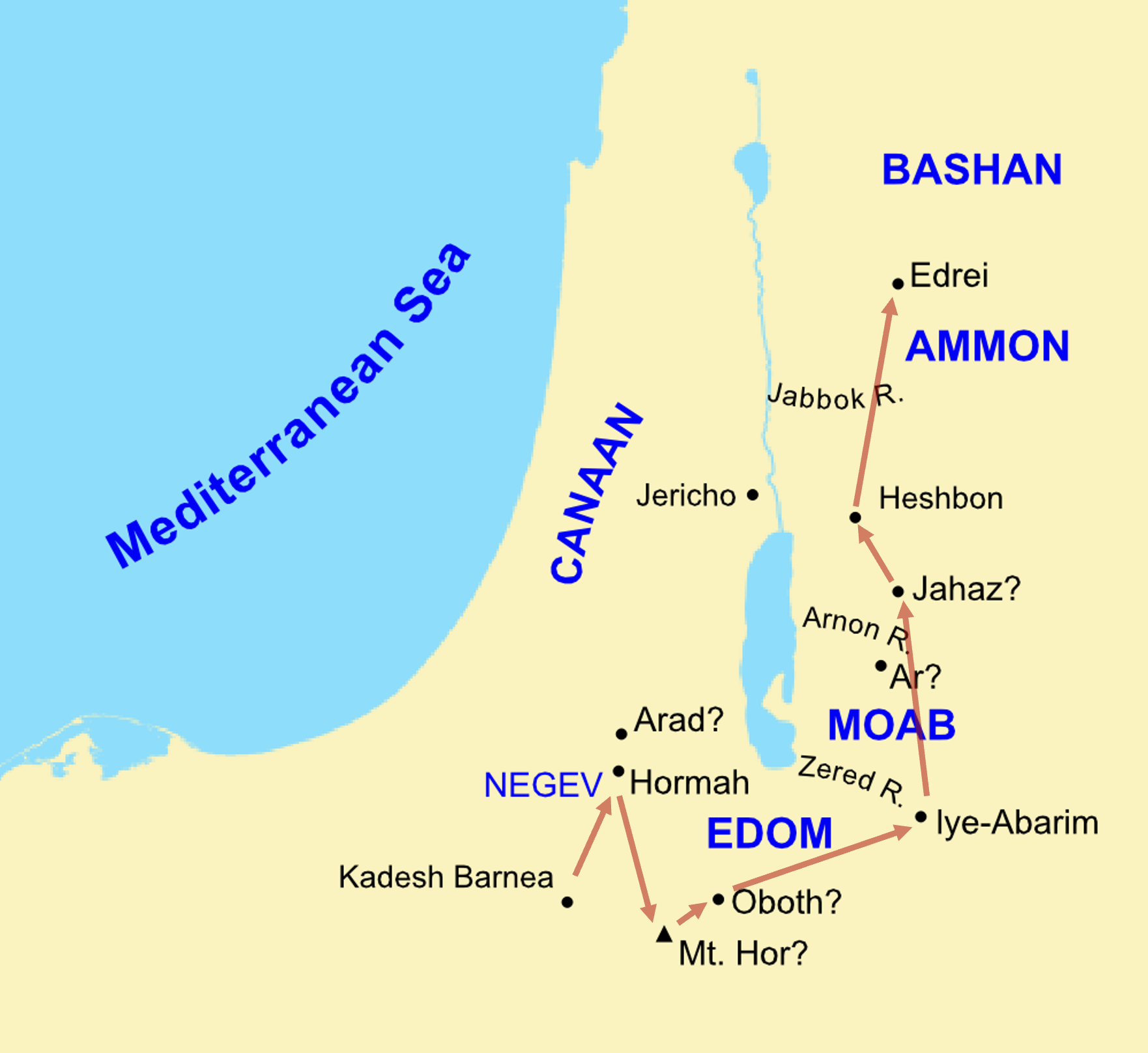
The first battle was against the king of Arad who came out against Israel, but Yahweh enabled them to soundly defeat him (verses 1–3). Israel had vowed to completely destroy Arad and his towns. “Completely destroy” in Hebrew meant to devote something completely to Yahweh, in this case, by wiping out all signs of evil. The Canaanite culture was totally wicked, especially their religious practices, and Yahweh was using Israel as His instrument of punishment (Genesis 15:16). This battle was in complete contrast to the battle 38 years ago at Kadesh-Barnea, when Israel went to battle without God’s command (Reading 74).
Next, they faced Sihon of the Amorites. Israel initially sought permission to pass through his territory but King Sihon refused and came out with his troops. Israel fought them at Jahaz and Yahweh enabled them to win. The Israelites sang a taunt song that the Amorites had originally sung (verses 27–30) when they first drove out the resident Moabites.
Yahweh had told Israel not to invade Ammon (Deuteronomy 2:19), Edom or Moab (Deuteronomy 2:4–9) because these nations were distant relatives. The Edomites were descendants of Esau (Genesis 25:30), while the Ammonites and Moabites were descendants of Lot (Genesis19:36–38). And so Israel moved northwards.
The third battle was with Og of Bashan. The victory against Og was significant as his people were more powerful than Israel. Og himself was giant-sized. Deuteronomy 3:11 mentions that Og had an iron bed measuring 4m by 1.8m (14 ft by 6 ft)! But once more, Yahweh gave victory to His people.
These were training battles, helping Israel see how Yahweh would win all battles for them when they obeyed.
It’s one thing to have victory in battle and quite something else to have long-range, daily endurance. While on the long march through the wilderness going around Edom’s territory, the people again grew impatient and began complaining.
Their anger grew into harsh words against God and Moses. In their attitudes and words, they were testing Yahweh, which is never wise to do. The people forgot Yahweh’s power and promises. They forgot that for 38 years, He had miraculously supplied water and bread from heaven. They had said the manna tasted like honeyed wafers (Reading 47). Now they were sick of it. They were taking God’s provision for granted.
In the past, Yahweh warned them before punishing them. This time, He sent venomous snakes without warning. (Some translations refer to them as “fiery” snakes, perhaps in reference to their colour or how their poison burnt.)
The people admitted to Moses they had sinned against Yahweh. This was actually an improvement in their attitude, as previously, Moses had to take the initiative to mediate for them. But now they confessed their sin.
Instead of simply healing them, Yahweh instructed Moses to make a bronze serpent and mount it on a pole. Anyone who was poisoned had to simply look at the bronze snake and he or she would be healed.
Jesus made reference to this historical event in the gospel of John.
John 3:14–15
[14] And as Moses lifted up the bronze snake on a pole in the wilderness, so the Son of Man must be lifted up, [15] so that everyone who believes in him will have eternal life.
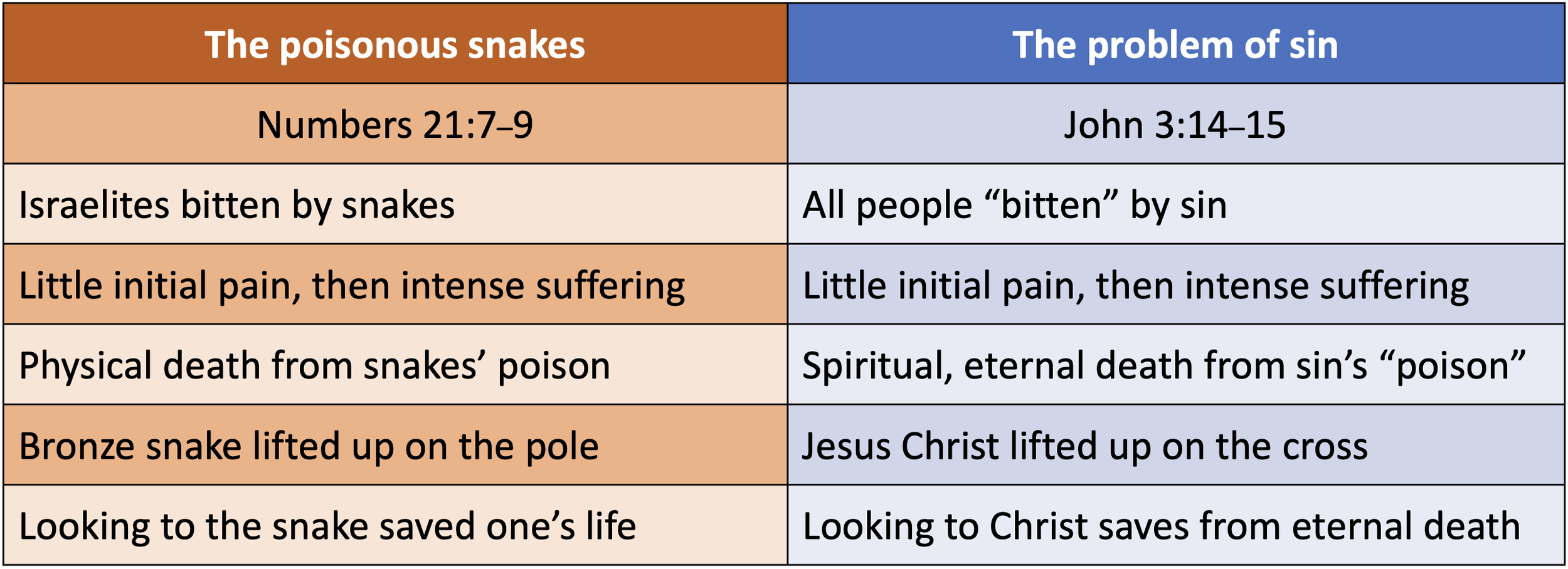
The comparison between lifting up the bronze snake in Moses’ day and lifting up Jesus on a Roman cross helps us better understand God’s grace in salvation.
All people are infected by sin and face eternal death. All people are unable to save themselves. But if they look in faith to Christ and His work on the cross, He will save them and give them eternal life. Just as the poisoned Israelites could do nothing to save themselves from physical death, all people can do nothing to save themselves from eternal death. But looking to Christ, or trusting Christ to save them, is the solution.
Jesus also mentioned the manna.
John 6:27–35
[27] But don’t be so concerned about perishable things like food. Spend your energy seeking the eternal life that the Son of Man can give you. For God the Father has given me the seal of his approval.”
[28] They replied, “We want to perform God’s works, too. What should we do?”
[29] Jesus told them, “This is the only work God wants from you: Believe in the one he has sent.”
[30] They answered, “Show us a miraculous sign if you want us to believe in you. What can you do? [31] After all, our ancestors ate manna while they journeyed through the wilderness! The Scriptures say, ‘Moses gave them bread from heaven to eat.’”
[32] Jesus said, “I tell you the truth, Moses didn’t give you bread from heaven. My Father did. And now he offers you the true bread from heaven. [33] The true bread of God is the one who comes down from heaven and gives life to the world.”
[34] “Sir,” they said, “give us that bread every day.”
[35] Jesus replied, “I am the bread of life. Whoever comes to me will never be hungry again. Whoever believes in me will never be thirsty.
The bread that the Israelites received was miraculous, but it only sustained them for a day. They needed more the next day.
The true bread of life—Jesus—sustains all believers for eternity. Whoever puts trust in Jesus will have eternal life.
Here are some reflections for us.
The Israelites, though fed by the miraculous bread, grew to despise it. How about us? Jesus says He is the true bread from heaven. And He feeds us daily through His Word. Do we look forward to our daily bread or have we grown bored with it, or worse, grown tired of it and want something else? What else can possibly sustain us and grow us into spiritual maturity? (Hint: nothing!) What is our attitude towards Jesus and His Word? Talk to God about it.
Though the Israelites were not yet spiritually mature and frequently disobedient, God was gracious to lead them to early victories. He had assured Moses that Israel would conquer its enemies because He would go with them (Exodus 23:23; Reading 54). God also wants to give us victory over our enemies (which aren’t usually armed soldiers but problems related to sin). But we must first believe that He can help us. And we must take the steps He shows us. If we refuse to move forward in faith, we show distrust and won’t be able to conquer our sin issues.
Moses didn’t hide the bronze snake but made it visible to all who were willing to look at it and be healed. The uplifted snake was the only cure. In the same way, Jesus Christ is the only cure for mankind’s sin problem. Are we like Moses, lifting up Jesus so that others have an opportunity to look to Him in faith and live? Every person is personally responsible for the choice to look to Christ or not, but are we helping others know there is a solution to life’s most pressing problem?
The Devotional Journey: Bible Reading 77
Forty years since the departure from Egypt
Read Numbers 20:1–29.
Moses’ record of Israel’s journey jumps to the first month of the 40th year since their departure from Egypt. This has been their journey thus far.
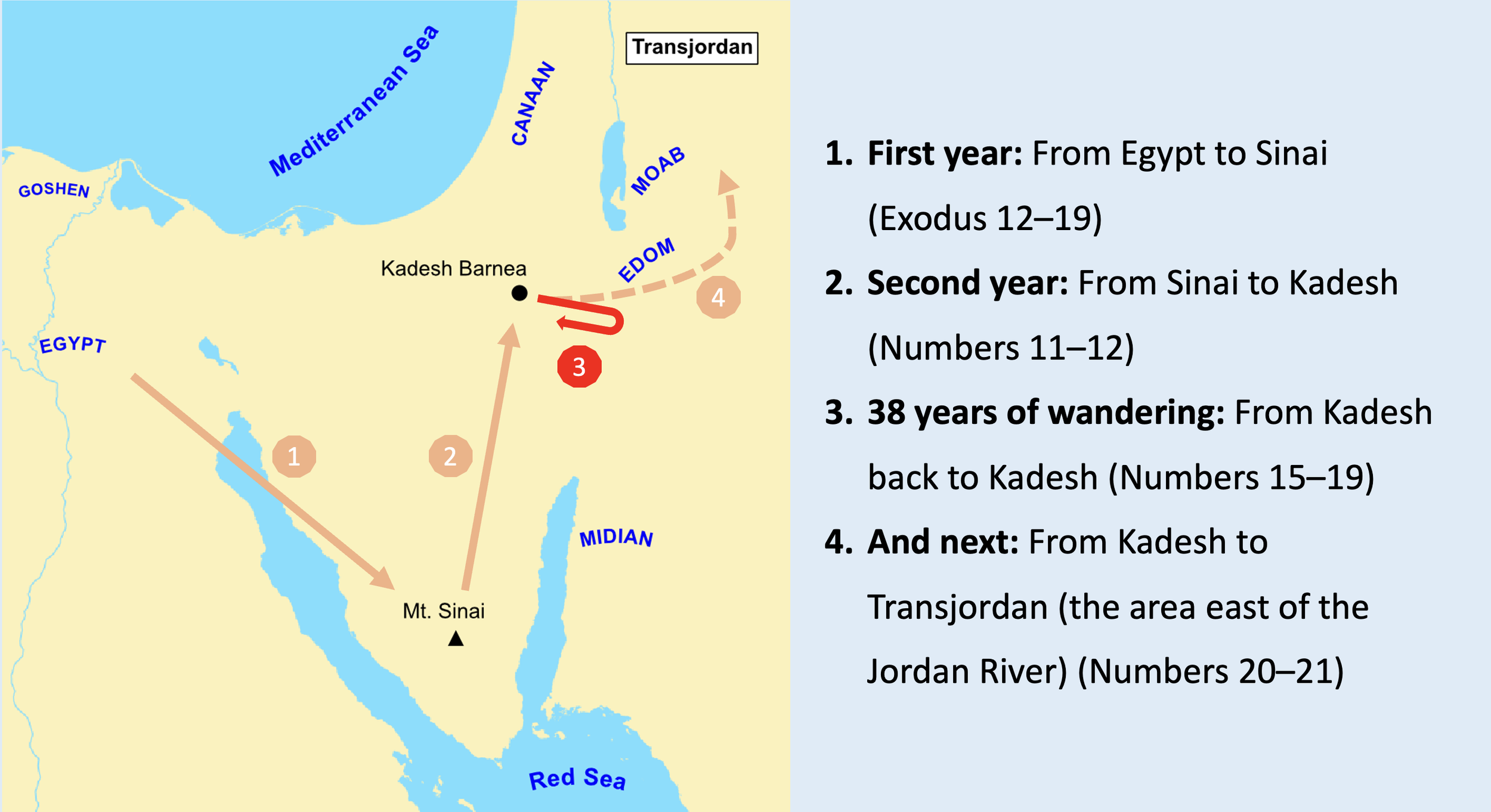
Numbers 20 begins with Miriam passing away at Kadesh. Though she was the most significant woman of the nation, no details about her death are recorded. It’s a stark reminder that Yahweh said all of the first generation would pass away because of disobedience before the next generation could enter the Promised Land (Reading 74).
It must have been hard for Moses and Aaron to lose their beloved sister. It was Miriam whom God used to save Moses’ life when he was a baby (Exodus 2:1–10). She had led the women’s praises after crossing the Red Sea (Exodus 15:20–21). And she had endured these last 38 years in the wilderness with her brothers. The only stain on her record was her criticism of Moses (Numbers 12). But even among those who are serious about God, who can claim to be spotless?
The chapter closes with the death of Aaron, the first high priest of Israel. He died because of rebellion. Though he was Yahweh’s chosen priest, God held him accountable for his sin (verse 24) and he didn’t get to enjoy the Promised Land.
We realise from Numbers 33 that 40 years had passed.
Numbers 33:37–39
[37] They left Kadesh and camped at Mount Hor, at the border of Edom. [38] While they were at the foot of Mount Hor, Aaron the priest was directed by the LORD to go up the mountain, and there he died. This happened in midsummer, on the first day of the fifth month of the fortieth year after Israel’s departure from Egypt. [39] Aaron was 123 years old when he died there on Mount Hor.
The middle of Numbers 20 records another sin of the people. Once again, the Israelites (most of whom were now the second generation since the first were dying out) complained about a lack of food and water. Instead of turning to God, they said they would rather die like the first generation than to suffer thirst!
They had forgotten that the last 38 years of wandering and hard living conditions were the result of their sin, rather than a failure of Yahweh to care for them. They should have gone on their faces to plead with God for help. Instead, they blamed Moses and Aaron yet again.
Moses and Aaron did the right thing and prayed to God. And Yahweh gave instructions. With the people watching, Moses was to take the rod and speak to the rock. The Hebrew word for rock in verse 8 referred to a cliff rather than a boulder. Yahweh wanted to show them again that He could solve their problem no matter the circumstances, provided they trusted and obeyed Him.
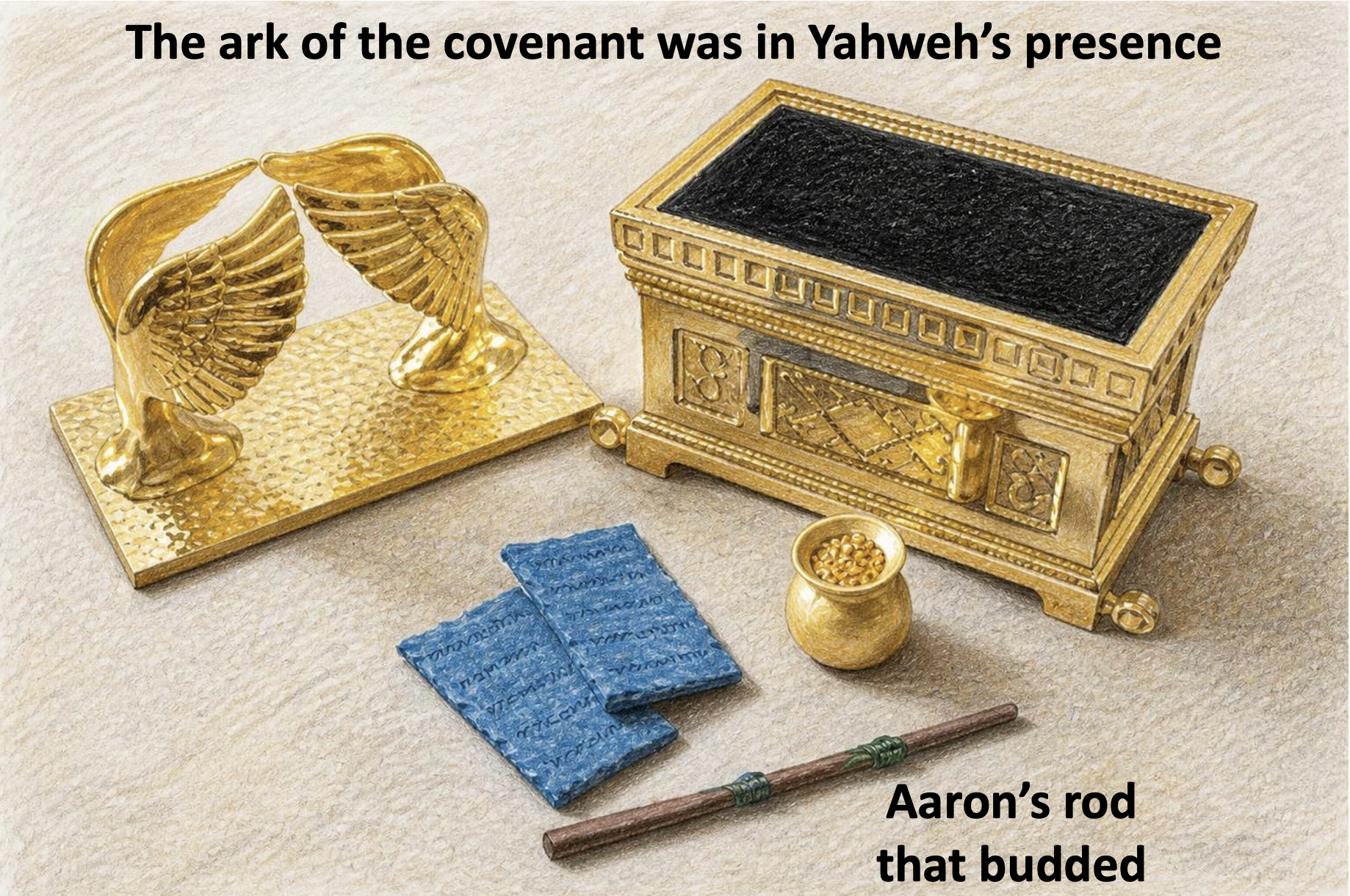
But alas, Moses didn’t trust God this time. Verse 9 says he took the rod from Yahweh’s presence. This probably referred to Aaron’s rod which budded. It was kept in the ark of the covenant which was in Yahweh’s presence. But instead of just speaking to the rock, Moses struck the rock face twice. He disobeyed! Nevertheless, Yahweh was merciful. Enough water gushed out to supply the nation and their animals.

However, Yahweh was displeased with Moses and Aaron’s lack of trust (verse 12). They should’ve trusted that what He had said was true and in faith followed His instructions carefully.
They failed to honour God and bring Him glory. As a result, Yahweh said both of them wouldn’t be allowed to lead Israel into the Promised Land. Though their eternal destiny remained with God, they suffered an earthly punishment for not acting in faith.
After this, Israel encountered hostility from Edom. This nation was a distant relative (through Jacob’s brother Esau. See Genesis 36:8 and Reading 17). Moses tried to establish friendly relations with them and seek permission to pass through their territory en route to Canaan. But the Edomites refused and their troops came out in a show of force. Moses wisely decided not to confront them in battle and directed Israel around Edom’s territory.
Challenging circumstances either help us mature or cause us to stumble in our journey toward spiritual maturity. Israel’s attitude showed they were still babes in their spiritual journey. God works to stretch and grow believers through trials. And He warns believers not to love the world—the values, attitudes and things that unbelievers consider valuable.
1 John 2:15–16
[15] Do not love this world nor the things it offers you, for when you love the world, you do not have the love of the Father in you. [16] For the world offers only a craving for physical pleasure, a craving for everything we see, and pride in our achievements and possessions. These are not from the Father, but are from this world.
When we’re facing difficulties, we mustn’t blame God for the circumstances. Sometimes, our circumstances are due to our own sinful attitude and decisions. And God uses our circumstances to humble us and fix our attitude. Until we humble ourselves to face the reality of the way we have lived, we'll have little peace and won’t grow spiritually.
See what Yahweh said about this incident at the rock which was called Meribah (Hebrew for “striving” or “contending”). (This is the second incident called Meribah. See Exodus 17:7.)
Psalm 95:8–11
[8] The LORD says, “Don’t harden your hearts as Israel did at Meribah,
as they did at Massah in the wilderness.
[9] For there your ancestors tested and tried my patience,
even though they saw everything I did.
[10] For forty years I was angry with them, and I said,
‘They are a people whose hearts turn away from me.
They refuse to do what I tell them.’
[11] So in my anger I took an oath:
‘They will never enter my place of rest.’”
The place of rest wasn’t eternity with God but the earthly, temporal Promised Land. The first generation (including Miriam, Aaron and Moses) didn’t get to enjoy the Promised Land because of disobedience and lack of faith.
As we reflect on these incidents, here are some thoughts for our own lives.
When facing difficult circumstances, can we be humble enough to admit that the difficulties could be due to our wrong thinking, sinful decisions or poor attitudes?
Can we recognise that God uses tough times to correct, train and stretch us spiritually?
When God speaks to us through His Word, will we trust what the Bible says and obey?
If God blocks off certain outcomes that we were hoping for, can we be like Moses and Aaron, and humbly accept the consequences and continue to obey and serve God with a good attitude?
The Devotional Journey: Bible Reading 76
Yahweh causes Aaron’s staff to blossom
Read Numbers 17:1–13.
Numbers 17 continues with what happened immediately after Korah’s rebellion. Yahweh had disciplined the Israelites because of their grumbling and rebellion, but the problem wasn’t yet resolved. Complaining was a persistent problem among the Israelites.
Yahweh had already shown that Aaron was His choice of high priest and that all priests would come from his family. But it didn’t seem enough so God provided one more act of authentication to put a stop to the grumbling against His appointed leaders.
He told Moses to get each tribal leader to bring a wooden rod with their name, representing their tribe, written on it. For the tribe of Levi, Aaron’s name would be inscribed on the staff.
The Hebrew word for rod or staff is matteh. And matteh also means “tribe”. This wordplay was God’s way of using the rods to confirm His choice of the family of priests.
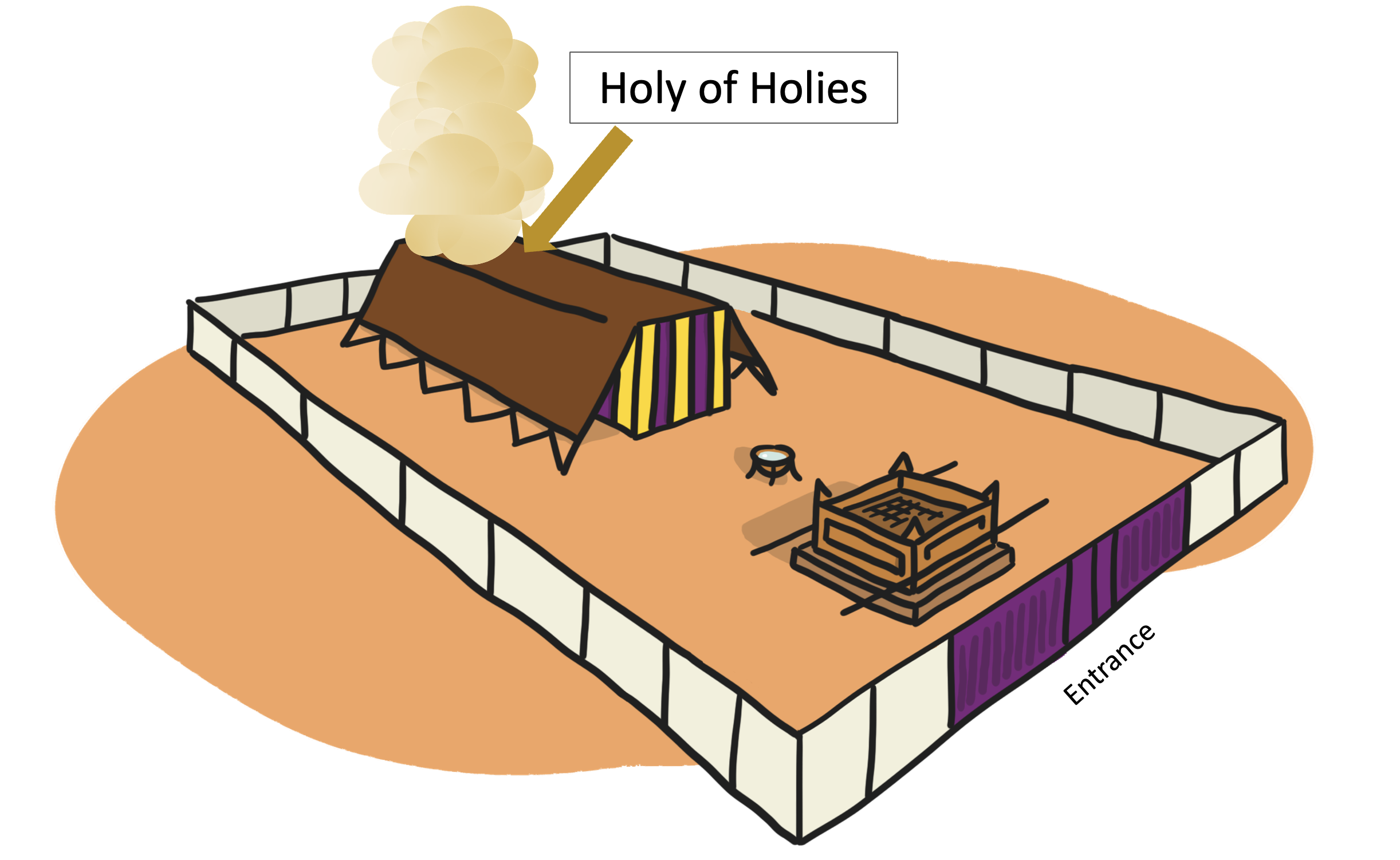
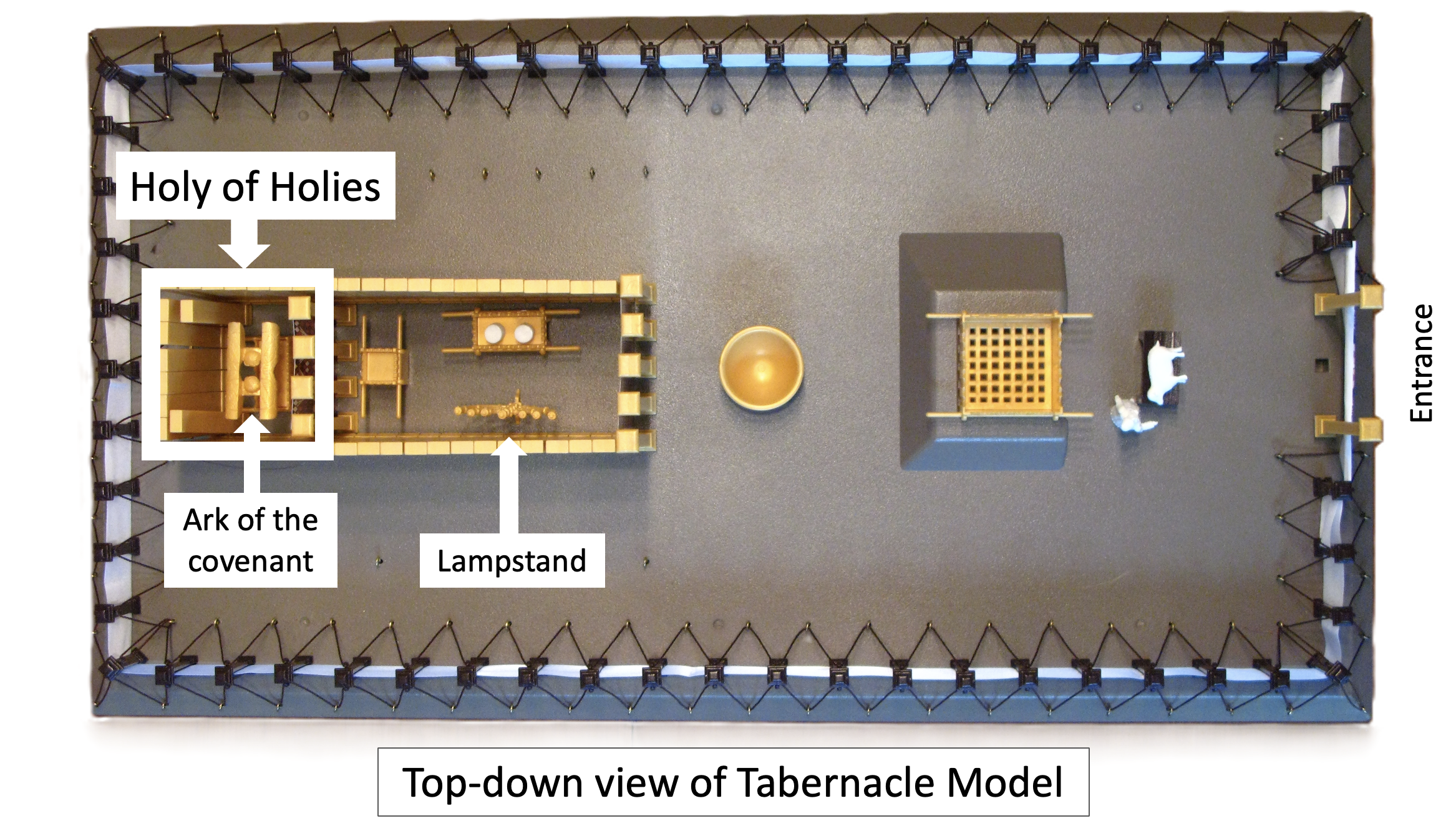
All the rods were brought into the Tabernacle and placed in the Holy of Holies, right in front of the ark of the covenant. The Holy of Holies, or the Most Holy Place, was the curtained-off square room where Yahweh’s presence dwelt above the ark of the covenant, the gold box containing the stone tablets with the Ten Commandments inscribed on them (Exodus 25:16), as well as a jar of manna that God had instructed Moses to keep (Exodus 16:32–34).
Yahweh said He would cause the rod of the man He chose to sprout. And indeed, Aaron’s rod not only sprouted, but there were almond buds, flowers and ripe almonds! It was a miraculous sign.
When Moses brought the rods out and returned them to the tribal leaders, they and the gathered people could see that Aaron’s rod had budded. This silenced the grumbling.
Then Yahweh instructed Moses to put Aaron’s rod in the ark of the covenant as a permanent reminder to the nation that Aaron and his family were the chosen priests, and no one else.
The message was clear. Just as Yahweh could make a dried, dead rod miraculously bear fruit, He could choose a family from among the people and enable them to render priestly service fruitfully.
In fact, the dead rod springing to life was a picture of how God could lead His chosen Saviour to die on a wooden cross but then cause Him to spring back to life to provide salvation for all people who would trust God for salvation.
The choice of almonds was also interesting. Almonds in Hebrew (šaqed) sounds similar to the word “guard” or “watch” (šaqad). It suggested that Aaron’s role as high priest was that of a spiritual guardian of the people. Almond flowers were also white, which symbolised the high priest’s purity and holiness.
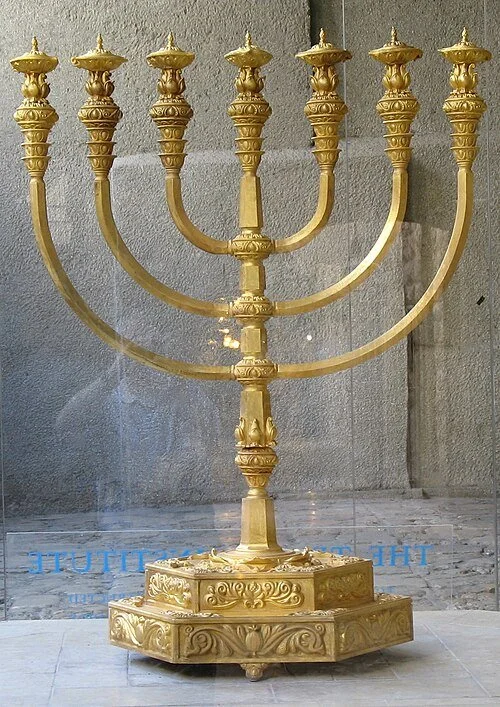
A reconstruction of the menorah of the Temple in Jerusalem, manufactured by the Temple Institute. The cups at the tips holding the oil lamps are shaped like almond flowers. Photo by By ariely - The Temple Institute, Jewish Quarter, Jerusalem. Public Domain.
Also, in the Tabernacle was a gold lampstand. The cups of the lampstand holding the oil lamps were shaped like almond blossoms (Exodus 25:32, 37). When Aaron’s rod blossomed with almond flowers, it really heightened Yahweh’s selection of him as the high priest.
The ark of the covenant now contained three items: (i) the two stone tablets of the Ten Commandments, (ii) the jar of manna and (iii) Aaron’s rod.
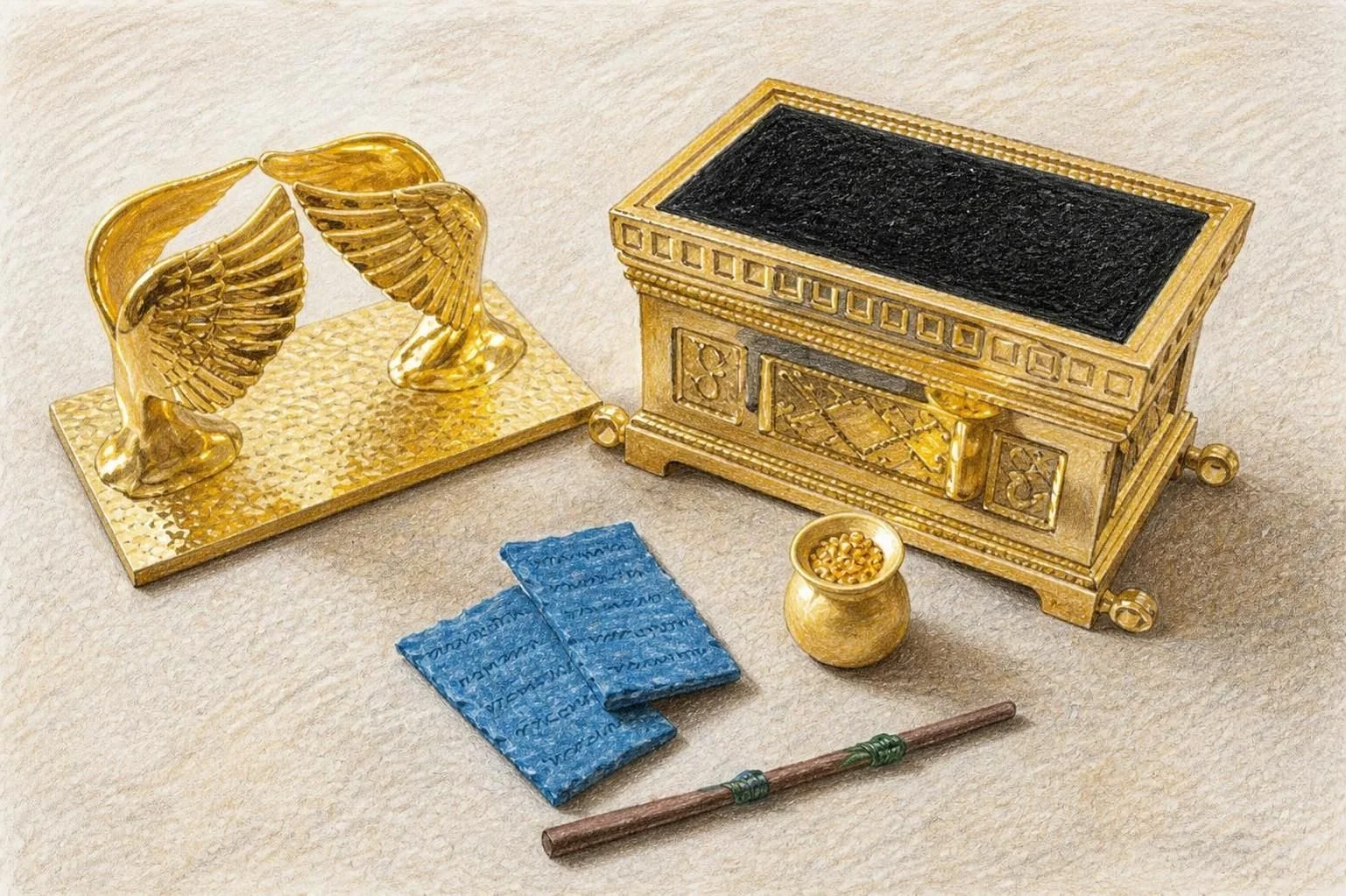
Sketch of the golden ark of the covenant with the cover (known as the mercy seat) featuring the two cherubim, the ark (the gold chest) itself, the two stone tablets, the jar of manna and Aaron’s rod which had budded.
They served as reminders.
The stone tablets reminded Israel of their covenant relationship with Him but also how they broke Yahweh’s laws repeatedly.
The manna reminded them of God’s miraculous provision but also their disobedience and grumbling about His provision.
And now Aaron’s rod reminded them of Yahweh’s choice of the priestly family and their rebellion against God’s choice of leadership.
These items were symbols of God’s grace and served as warnings to future rebels and grumblers.
This time, the people learnt the lesson. Before, they grumbled that anyone could serve Yahweh at the Tabernacle. But now they thought they would all die if they got too close to the worship tent. But Yahweh would not kill the nation if they followed the guidelines He gave in Numbers 18.
Reflecting on our own lives, how do we feel about God’s leading and provision? Do we complain and grumble against Him? Perhaps we don’t do it aloud, but do we have a discontented attitude to how God is directing our lives?
The Bible warns us that grumbling is a sin.
1 Corinthians 10:10
And don’t grumble as some of them did, and then were destroyed by the angel of death.
Philippians 2:14
Do everything without complaining and arguing,
When we grumble, we show we don’t trust God and we lack gratitude.
When we catch ourselves grumbling, let’s tell ourselves to stop immediately. The Israelites had experienced so much of Yahweh’s provision: supernatural rescue from Egypt, miraculous provision of food, protection from enemies, and a Father-son relationship with God. Yet, they didn’t appreciate Him.
We too have received many blessings. We have been reconciled to God through faith in Christ. We have the permanently indwelling Holy Spirit. We have God’s Word to guide us. We have access to God through prayer. And He has placed us in His family, the body of Christ.
Let’s take some time to remind ourselves of all our answered prayers, God’s provision in our lives and the blessings He has given us personally. Let’s focus our thoughts on what He has done for us and be grateful, and our complaining will fade away.
The Devotional Journey: Bible Reading 75
Yahweh reaffirms His choice of Aaron and Moses when Korah, Dathan and Abiram rebel
Read Numbers 16:1–50.
We had learnt that Yahweh originally chose the firstborn sons of the nation to serve Him. But when Israel rebelled at the golden calf idol incident (Reading 57), the Levites remained loyal. As a reward, Yahweh gave the Levites the special role of serving Him at the Tabernacle instead of the firstborn sons (Reading 69). In addition, from among the Levites, Yahweh also appointed Aaron and sons as priests and all subsequent priests were to come only from Aaron’s descendants.
Now, another rebellion had formed. Angry that the present adult generation couldn’t enter the Promised Land, a group challenged the religious authority (Aaron) and the political authority (Moses) that Yahweh had installed.
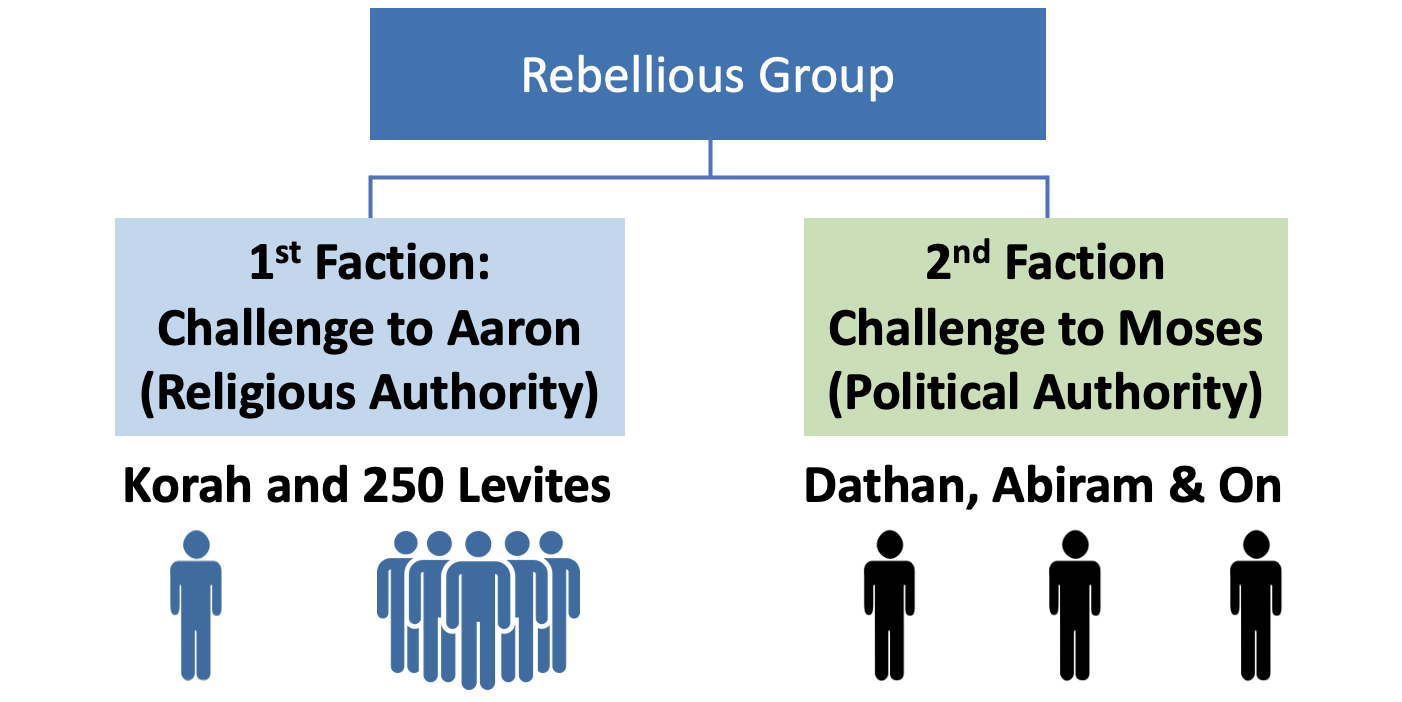
One faction was led by Korah and 250 Levites. Korah was a cousin of Aaron and Moses and might have thought he was as qualified as Aaron to be high priest.
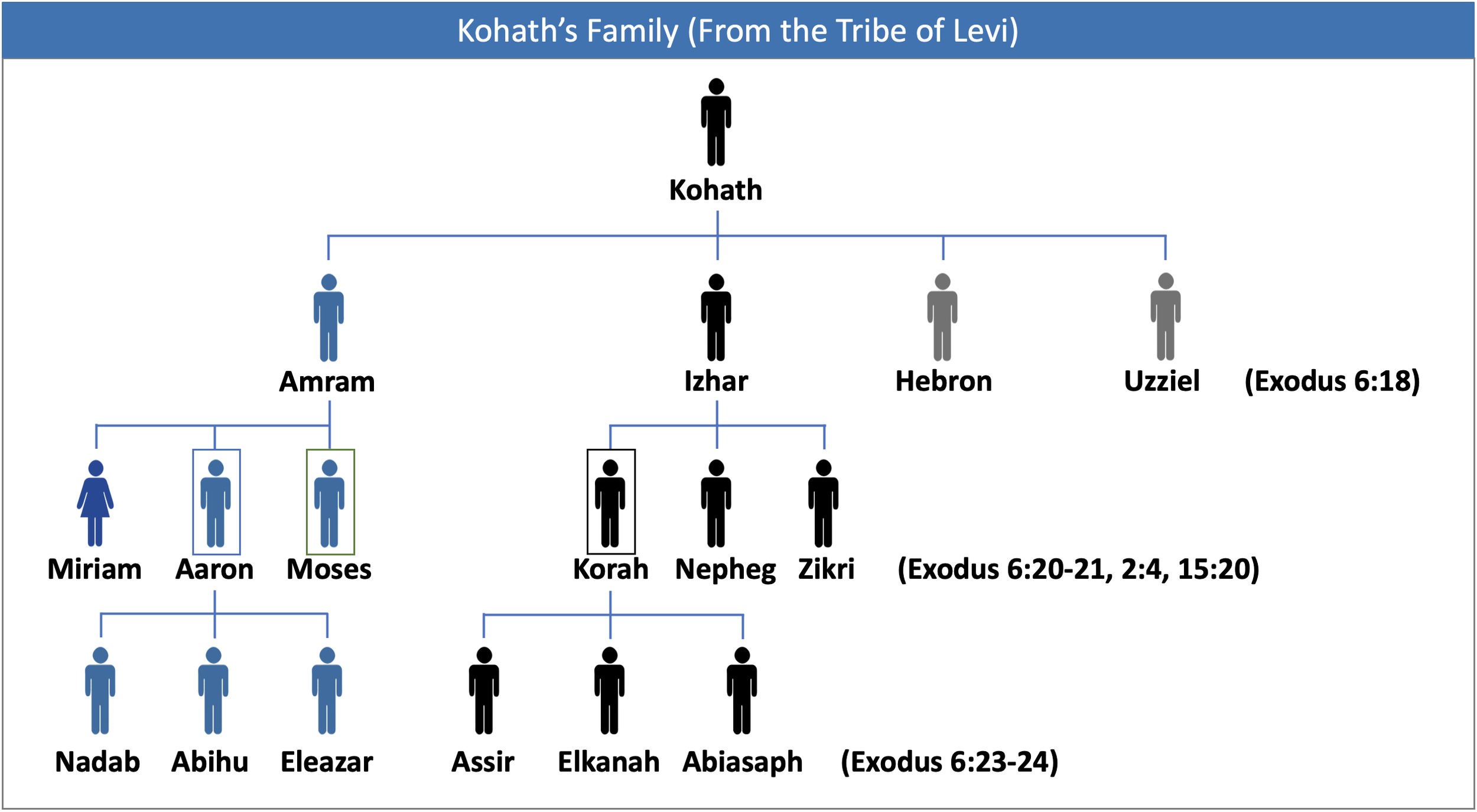
The second faction was led by Dathan, Abiram and On, from the tribe of Reuben (Jacob’s oldest son). They probably felt that coming from the eldest tribe, they had as much right to lead the nation as Moses did.
Their accusation was threefold:
Moses and Aaron were no better than anyone else
Everyone in Israel was part of the chosen nation
They didn’t need to obey Moses and Aaron.
While the first two statements were true, they drew the wrong conclusion. They completely ignored the fact that Moses and Aaron were Yahweh’s choice of leaders.
Moses brought the leadership challenge before Yahweh. He told Korah and his Levite followers to bring censers. The bronze censers were shallow bowls with long handles used for burning sweet-smelling incense. The incense represented the prayers of the people and were part of the worship of Yahweh. Moses said God would make His choice of high priest clear.

As for the political challenge to Moses’ leadership, he summoned Dathan and Abiram to appear before God. But they refused! (Nothing more is said about On, the third challenger. Perhaps he had changed his mind.)
Dathan and Abiram made baseless accusations, including calling Egypt a “land of milk and honey”. They were envious of Moses’ position. Moses’ response shows us what we ought to do when there are leadership challenges. He prayed, asking God to clear his name. The anger Moses had wasn’t a selfish irritation but the righteous indignation of a man who only cared about Yahweh’s glory and His ways.
Yahweh responded dramatically the next morning. Korah and his followers showed up with their censers and stood with Moses and Aaron at the entrance of the Tabernacle.
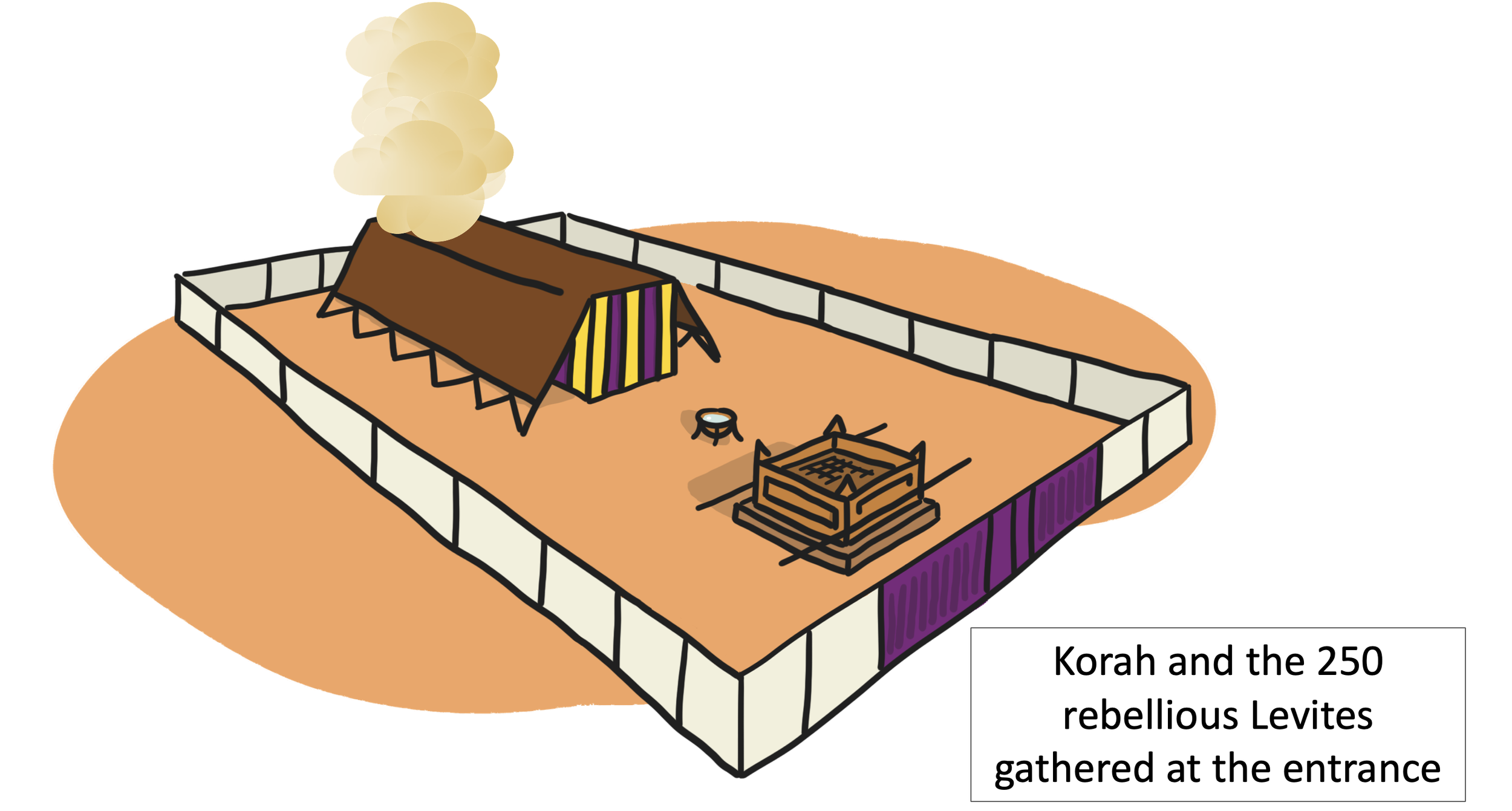
Meanwhile, Dathan and Abiram stood with their families at the doors of their tents, within sight of the south side of the Tabernacle.
Yahweh’s visible glory appeared and His voice could be heard. Moses and Aaron fell to their knees in reverence and prayed for the nation. Why should the nation suffer because of these two rebellious factions?
God warned the people to move away from the tents of Korah, Dathan and Abiram. Then the ground opened up and swallowed the evil men and their households! And fire or lightning from the sky flashed down from God and destroyed the 250 Levites. This was a dramatic end to the rebellion. Yahweh made it very clear that the Israelites were to accept His appointed leaders and respect their authority.
God told Eleazer the priest to collect the bronze censers of the rebels and make a cover for the altar where the sacrificial animals were burnt. The covering would remind Israel about this rebellion.
The next day, the rebellion wasn’t quite over. Now there were others accusing Moses and Aaron of getting fellow Israelites killed. Yahweh intervened again, sending some kind of plague that began killing the complainers. Moses commanded Aaron to take his censer, burn incense and run among the people, letting the incense smoke spread among them. When he did that, the plague subsided, but not before another 14,700 died that day. (Instead of simply praying to intercede for the people, Aaron physically used incense which represented prayer. See Psalm 141:2 and Revelation 8:3–4.)
Whether it is ancient Israel or a modern city, every society functions with an authority structure. Someone has to be in charge. Parents are in charge of the children. Teachers are in charge of the class. Managers are in charge at work. Elected officials and civil servants run society. When order breaks down, there will be trouble.
Moses and Aaron were appointed by God to lead the nation and rebelling against them was rebelling against Yahweh. It brought serious division. The selfish desire for authority is a common theme in Scripture. Every follower of Christ needs to learn that the most important place for us to be is the position of God’s choosing, the place and role He wants us to serve. Every member of Christ’s body is given a spiritual gift that is meant for serving others. We do well to use our gift in building up the body (see 1 Corinthians 12:14–18).
One other interesting observation is that despite what happened to Korah, God was still willing to use his sons. In Numbers 26:11, we learn that the sons of Korah didn’t die in the incident. In fact, his sons went on to be musicians for Yahweh and wrote psalms that are now part of the Bible (Psalms 42, 44–49, 84, 85, 87 and 88). This shows that the arrogance of the father didn’t pass down to his sons and God doesn’t hold the sin of the father against the children.
Think about who God has placed over us in this season of our life. What is our attitude towards them? Do we willingly submit to these ones knowing that will please the Lord? Or do we feel superior to them and are arrogant in our attitude towards them? Pray and ask God for help that we might have a God-honouring and cooperative attitude towards those whom God has placed over us.
Also think about who we are responsible for in this season of life. Do we share Moses’ and Aaron’s attitude of concern where they passionately pray and intercede for the people? Do we have a good heart attitude towards them that guides our words and actions? Do we serve them in the way that God wants us to? Let’s talk to God about this.
The Devotional Journey: Bible Reading 74
Israel rebels against Yahweh’s command to enter the land
Read Numbers 14:1–45.
In the previous reading, ten of the spies reported that Canaan, the Promised Land, was too hard to conquer. They claimed Israel would be destroyed in the attempt. But Caleb and Joshua insisted that with Yahweh’s help Israel could conquer the land. The people had to choose between the two conflicting reports. Which report was right? More importantly, what they did think of Yahweh and His commands?

The nation chose to weep! Their fear overtook them. This was shocking because they had already experienced Yahweh’s power through the Exodus and they had experienced one year of His provision and protection in the wilderness. Not only that, they had Yahweh’s promise of the land in the unconditional Abrahamic Covenant. They should have known Yahweh would keep His promise. They should have trusted that He would lead them in the taking of the land.
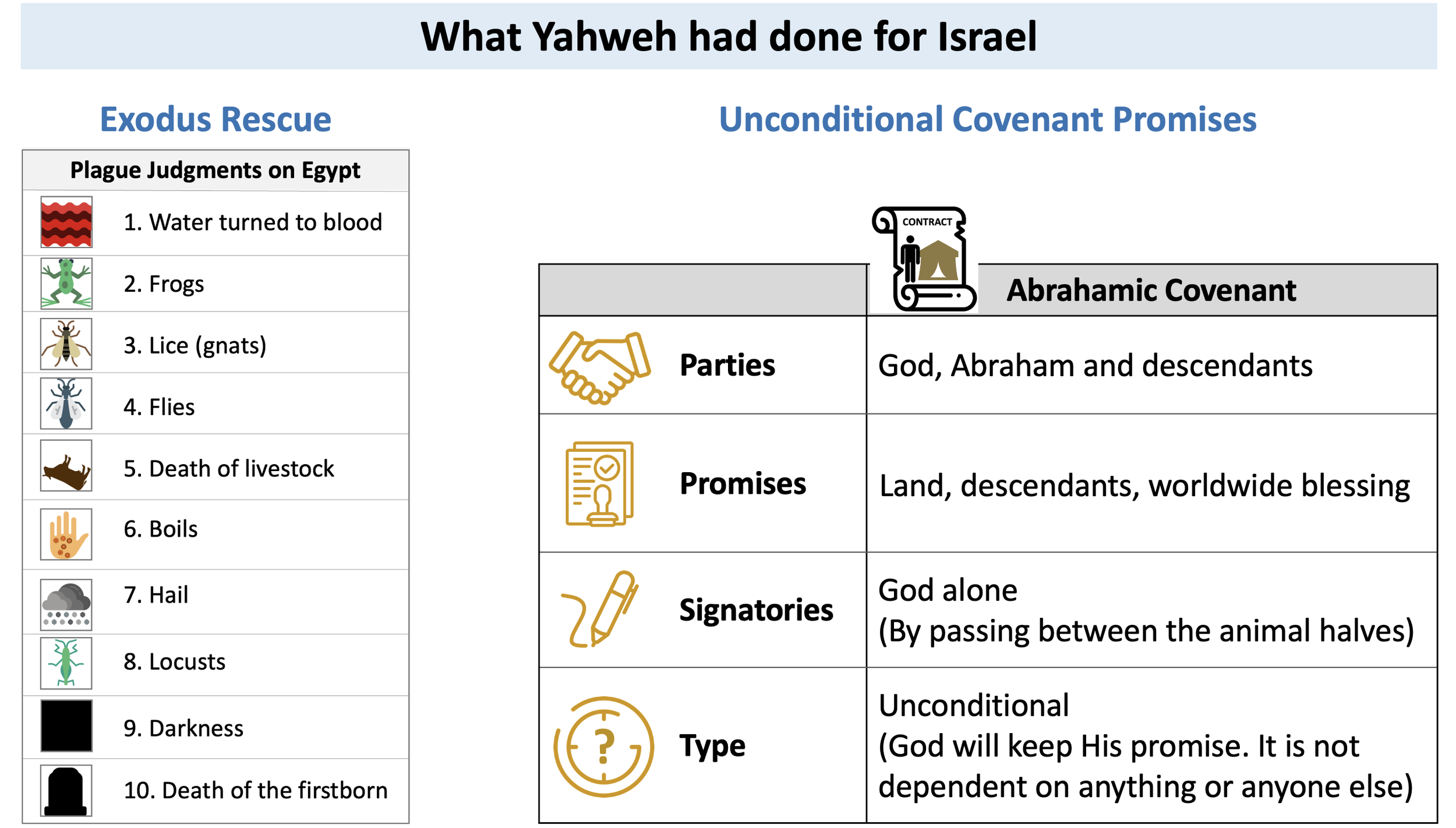
But instead of trusting Yahweh, they let their emotions take over. They panicked over a situation they had created in their minds. Their panic was so great, they wanted to choose new leaders and head back to Egypt, the land where they had been enslaved for 400 years! This was an example where an unreasonable fear of the future caused the people to shrink back. Fear and unbelief can lead God’s people down wrong paths of thinking.
Four men intervened. Moses and Aaron went before Yahweh and prayed for Israel. Caleb and Joshua told the people not to rebel against God’s instructions. He would give them the land. All they had to do was be obedient. Caleb and Joshua saw the people’s reaction for what it really was: it was sin against God’s instructions.
For the second time, God announced He wanted to destroy rebellious Israel. (The first time was the incident with the gold calf idol in Reading 57.) But Moses interceded once more, reminding God that Israel was His witness. If Israel were destroyed, the pagan nations would think Yahweh was powerless to keep Israel secure.
So God acted in accordance with His character. “The LORD is slow to anger and filled with love… But He does not excuse the guilty. He lays the sins of the parents upon their children…”
What did this mean?
God was merciful. He would not destroy all of Israel. But as the all-righteous God, He could not ignore sin. He would punish the disobedient adults. They would not be allowed to enjoy the Promised Land. Rather, they would live in the wilderness until they died. (Note that this punishment was about how the adults of Israel failed to walk in obedience during their lifetimes. It was a failure of sanctification. God allowed physical death to end their mortal lives. But their justification and eternal life are not in question as those were secured by God.)
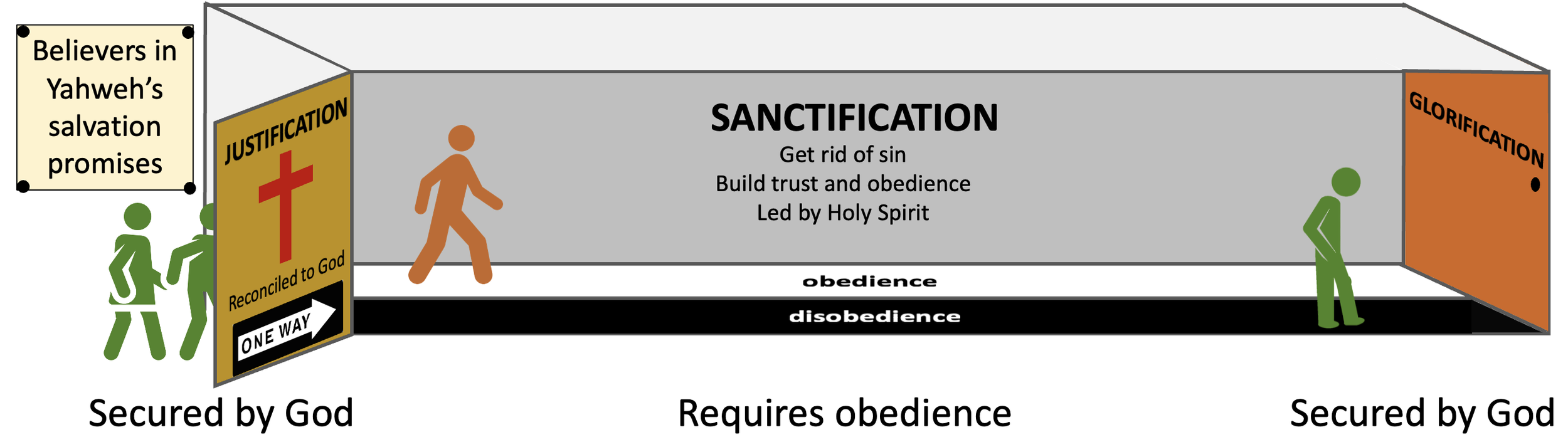
After the parents’ death, their children would conquer the land and enjoy it. But they would have to wait till their parents’ generation died. Though God was not punishing the children, He permitted the sad effects of sin to play out and in this way, the children were impacted. (That’s what it means to have the sins of the parents laid upon the children.)
The day after this, the rebellious Israelites didn’t want to accept God’s judgment on them and thought they could make things right by obeying God’s earlier command. But it was too late. Once God deals with sin and moves on, there is no going back. Though the Israelites charged into battle, they lost because God did not go with them.
What can we learn from this sad incident?
When the people of God are in the will of God, there is no place for complaining, even if the circumstances are difficult. When God directs our lives, we must be assured that God will never lead us where His love, grace, wisdom and help can’t reach us. Therefore, it’s important to know God well. For us, the study of His Word, and our daily obedience to His Word will build our experience with God.
For example, when we read in Romans 8:28 that God causes everything (both the good and bad things in our lives) to work for our good, do we personally believe this to be true for our lives? When we are in a difficult situation, do we still believe that the difficulty will eventually produce something good in our life, that God is doing something behind the scenes to grow us?
A believer who is slow to obey and who complains about God’s will is showing a heart that is not surrendered to Him. When we grumble about God’s guidance in our life, we are showing we think we know better than Him. We are questioning His love, wisdom and power. We will be rousing Him to discipline us!
When we walk only by what our eyes can see but not through the eyes of faith in God, we will forget who He is and stumble. We may shrink back and even give in to fearful emotions. Let’s not live this way. Instead, let’s be regular about learning more about God and to trust His Word and His character. Let’s also review how He has led us in life’s journey. When we exercise these spiritual disciplines, we won’t be so easily spooked when the paths that God leads us on become challenging.
Is there anything challenging or difficult in your life right now? Tell God about it. And turn to His Word for understanding of how He uses tough times to grow His people.
Take some time to read the following verses about endurance in tough times:
Romans 5:3–5
Romans 8:28
Hebrews 10:32–36
James 1:2–8.
The Devotional Journey: Bible Reading 73
Yahweh allows the Israelites to scout out the land of Canaan
Read Numbers 13:1–33.
At Yahweh’s command, the Israelites broke camp and headed to the southern part of the Promised land, to a place known as Kadesh-Barnea. They were supposed to enter Canaan from here. This was an important moment for them as God was acting on His covenant promises to Abraham to give his descendants the land.
The Bible tells us that the people wanted to survey the land first. In the book of Deuteronomy (the last book that Moses wrote), Moses recorded that the original idea to spy out the land came from the people. Yahweh agreed to their request and told Moses to choose 12 men, one from each tribe of Israel. They would go on this survey trip.

Deuteronomy 1:19–25
[19] “Then, just as the LORD our God commanded us, we left Mount Sinai and traveled through the great and terrifying wilderness, as you yourselves remember, and headed toward the hill country of the Amorites. When we arrived at Kadesh-barnea, [20] I said to you, ‘You have now reached the hill country of the Amorites that the LORD our God is giving us.
[21] Look! He has placed the land in front of you. Go and occupy it as the LORD, the God of your ancestors, has promised you. Don’t be afraid! Don’t be discouraged!’
[22] “But you all came to me and said, ‘First, let’s send out scouts to explore the land for us. They will advise us on the best route to take and which towns we should enter.’
[23] “This seemed like a good idea to me, so I chose twelve scouts, one from each of your tribes. [24] They headed for the hill country and came to the valley of Eshcol and explored it. [25] They picked some of its fruit and brought it back to us. And they reported, ‘The land the LORD our God has given us is indeed a good land.’
In July, these 12 men entered the land to see what it was like (Verse 20 says it was the season of the first ripe grapes, which is around July). It was filled with good and plentiful food! They gathered pomegranates, figs and a cluster of grapes so huge that two men had to carry it on a pole!

Forty days later, when the 12 men retuned to give a report, it almost seemed as if the scouts had gone to two different places!
Ten of them gave a bad report. They admitted that the land was wonderful, flowing with milk and honey, meaning that it could sustain lots of livestock and animals and also, there was plenty of fruit trees and vegetation. They even showed the fruits they had brought back. (Notice how this description matched what Yahweh had already told them. They actually didn’t need to investigate as God had told them what it was like!)
However, the scouts added that Israel wouldn’t be able to conquer the people of the land. One of the people groups was extremely tall, so they seemed like giants to the ten men. The ten scouts told the people they shouldn’t enter the land for Israel would be defeated. (Notice how this assessment didn’t agree with what God had promised to do for Israel! Their fear made them distrust Yahweh.)
One of the other two remaining scouts, Caleb, said they could and should go into the land. They would definitely be able to conquer it! Both Caleb and Joshua shared the same perspective.
Why was there such a difference in the reports by the scouts?
All the men had seen Yahweh at work at the time of the Exodus. All of them experienced God supernaturally using natural forces to show His power to Egypt during the 10 plagues. All of them experienced how Yahweh had led them out of Egypt without a single loss of life. All of them saw God stop the Egyptian army from capturing them at the Red Sea.
Caleb (and Joshua) knew what Yahweh was capable of. They had seen and experienced Him! They trusted that just as God had defeated the Egyptian army, He would easily defeat the Canaanites. They focused on who Yahweh is and His history and track record. This gave them the faith and courage to say that they could and should enter the land. With God, they would win! Their faith was built on Yahweh’s demonstrated character.
On the other hand, the remaining scouts focused on the threat: the enemies seemed so big! Their cities were so well fortified! They focused on their fear. They focused on their emotions and made a decision based on feelings rather than truth. They blocked out all memories of Yahweh and what He had already done for them. They chose not to trust God’s Word and His promises to them. Unbelief in the life of God’s people is serious because it challenges the character of God and rebels against His will.
When we are faced with choices, do we focus more on our feelings or do we focus on our God? Are our eyes set on the threat and challenge ahead of us or are our eyes set on God and what He has already done and can do?
Let us learn from Caleb. He knew what Yahweh had promised: God would lead them into the land. God would win the battles for them. He chose to trust in Yahweh. He remembered what God had already proven: He is all-powerful and all-loving. He is their God. And Caleb’s choice was to do as God said: move into the land. Caleb exercised a faith that was based on a reliable track record of God.
Think about the choices that lie before you. Pray to God about these choices. Ask God to guide you on the decision to be made. Is God guiding you to make the choice that seems very hard? If so, review the kind of God that He is. Is Yahweh a promise-making, promise-keeping God? Is He all-powerful? Is He all-loving? What is His track record like? When our faith is being tested by a tough situation, pray and ask God to help you be like Caleb instead of the ten faithless men.
Archaeological Note
Canaan was the ancient name of the Promised Land that Yahweh promised to Abraham and his descendants. In a collection of ancient clay tablets known as the Amarna letters, written between the representatives of Canaan and Egypt, the name “Canaan” was used to refer to the land that would later be called Israel.
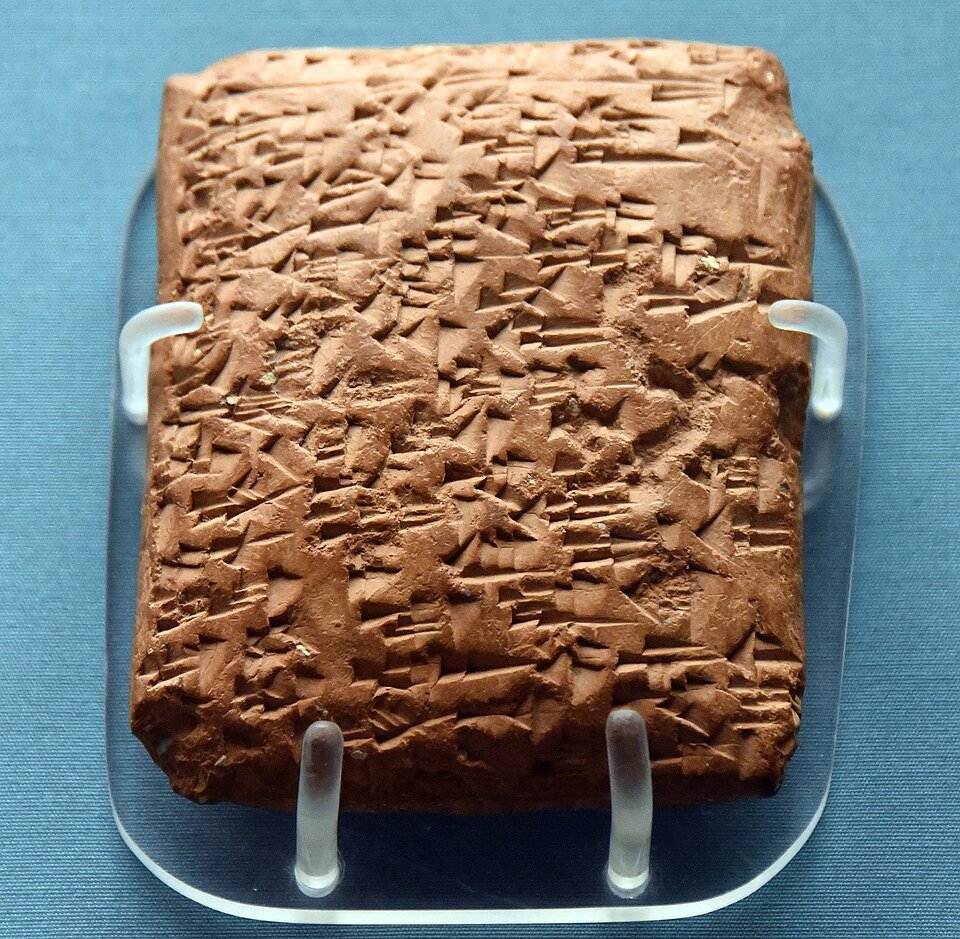
An example of the Amarna Letters, written in Canaanite alphabetic cuneiform script. Photo by Osama Shukir Muhammed Amin FRCP(Glasg) - Own work, CC BY-SA 4.0. Wikimedia Commons.
At the time when Israel reached the borders of Canaan, the Canaanite culture was at its strongest and most influential. Excavations at several sites reveal strong, fortified towns and cities, a semi-agricultural economy and the worship of false fertility gods like Baal, Asherah and Ishtar. These idols were worshipped at specially constructed high places or at sacred trees. There was gross immorality and lots of pagan practices by the peoples of Canaan. The Canaanite beliefs, culture and paganism were a direct contrast to Yahweh and the way of life He gave to Israel.
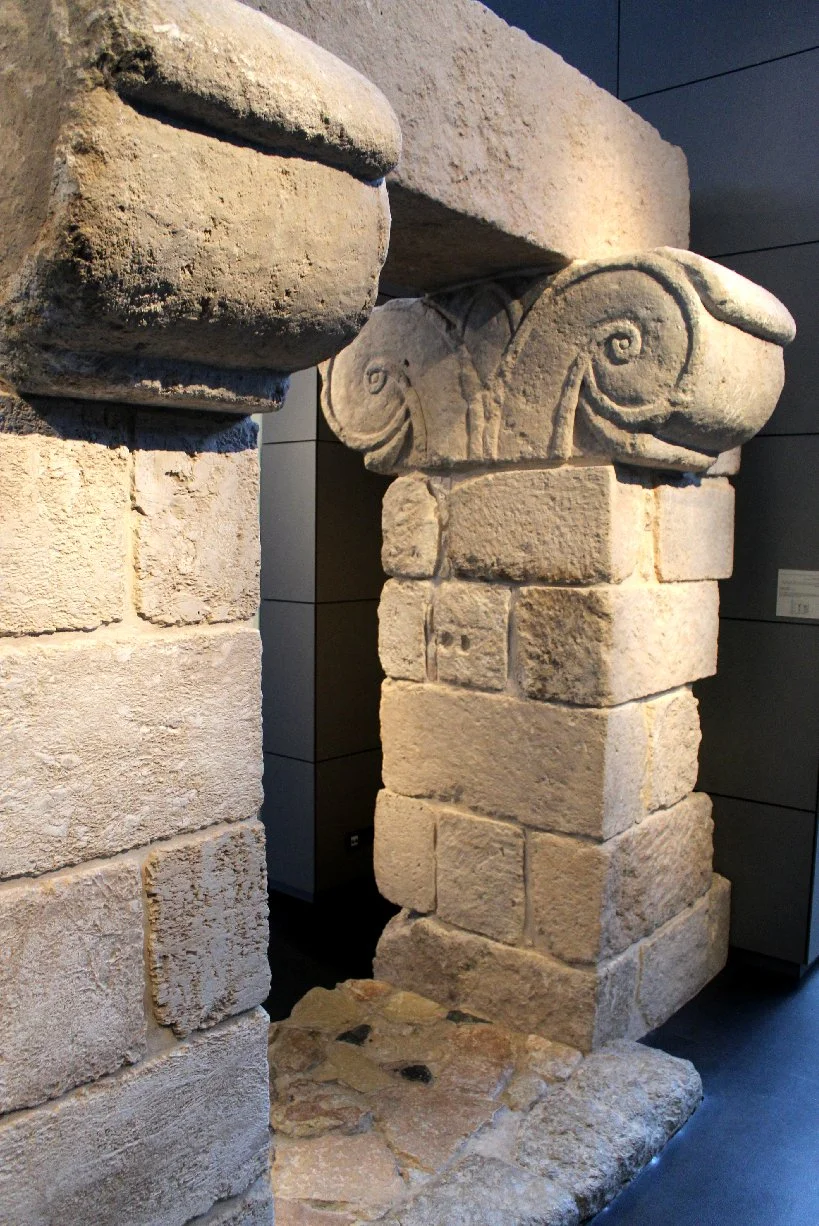
Royal fortress gate found at Hazor in northern Canaan. This is an example of the fortification that the Israelites encountered. Photo by By Davidbena - Own work, CC0. Wikimedia Commons.
The Devotional Journey: Bible Reading 72
Yahweh responds to the people’s complaints by appointing leaders and sending more quail
Read Numbers 11:1–35.
A month after Passover, Yahweh instructed Israel to break camp.
Numbers10:11–12
[11] In the second year after Israel’s departure from Egypt—on the twentieth day of the second month—the cloud lifted from the Tabernacle of the Covenant. [12] So the Israelites set out from the wilderness of Sinai and traveled on from place to place until the cloud stopped in the wilderness of Paran.
Perhaps travelling after a year of not moving was a drastic change because even though Yahweh was providing everything they needed, the people began to complain. The same thing had happened a year ago when God first led them to Sinai (Exodus 16). It took faith to accept God’s leading and Israel’s faith wasn’t very strong. As soon as they experienced discomfort, they complained.

Yahweh was displeased with their attitude and judged them with fire from heaven (possibly lightning) to burn those who grumbled bitterly. This swift judgment showed Yahweh setting expectations. He showed them what He expected of their behaviour. (We’ll see this pattern again and again.)
Then the “foreign rabble” complained about the food. These were non-Israelites who had followed Israel. Perhaps they followed in faith, or perhaps they wanted to escape from Egypt after all that happened. In any case, they were tired of the manna that Yahweh had provided for a year. (Verses 7–9 describe how the manna was actually good, fresh and had some variety to it.) They whined about the foods they missed in Egypt, for meat they claimed they ate in abundance. This was likely an exaggeration as they were slaves in Egypt and only had what the Egyptians permitted them. Sometimes, our memories of the past can seem better than the past actually was. (The people did have meat in the form of their livestock. But to eat their livestock would mean the loss of the means to make a living from the animals.)
Their complaints even got Moses so upset, he wanted to die! Even faithful servants of God can be worn down by persistent negativity, criticism and complaints. Moses lost perspective in the difficult circumstances.
Thankfully, Yahweh helped with both problems:
how to spiritually lead so many people and
how to provide meat for everyone.
For the first problem, Yahweh commanded Moses to select elders to assist him in leading the people spiritually. Earlier (Reading 50; Exodus 18:1–27), Moses had appointed leaders to help settle personal disputes among the people. Now God told Moses to select another 70 elders. During Old Testament times, the Holy Spirit did not permanently indwell believers. So here, God visibly demonstrated that He was providing these 70 elders with the Holy Spirit too, to enable them to share Moses’ load of caring for the people’s spiritual needs.

For the second problem about lack of meat, Yahweh supernaturally blew in countless numbers of quail. The birds flew so low to the ground that it was easy for the people to catch them. God overloaded the people with so much meat that they were overwhelmed. Not only that, God struck them with a plague!

There are lessons we can learn from this incident.
The people showed a lack of faith in God and were dissatisfied with His provision. In our own lives, do we think God is providing enough? Are His blessings too little? Is His Word too boring? Have we stopped talking to Him about our concerns and instead, resorted to complaining? God is more than powerful enough and caring enough. We need to remember that God cares, He listens, and His Word is the “daily bread” that is sufficient for our daily sustenance and growth.
God provides help. We don’t have to handle challenges on our own. God provided Moses with 70 Holy Spirit-guided elders to help him manage the people. Moses wasn’t indispensable. God enabled others to help. Similarly, do we find ourselves overwhelmed? God can provide help in the form of godly friends or counsellors. We don’t need to be alone in our challenges.
Even faithful leaders can sometimes lose sight of God in the face of criticism. When we face discouragement, let us run to God in prayer, and also to His Word. Do it quickly so that our negative thoughts don’t take over. Rather, we let God’s truth remind us of who He is and who we are in Him—we are dearly beloved children.
When God wants to judge people, He sometimes does so by letting people have their way. When we observe the choices of others, we might wonder why God allows certain things to happen. This is because God honours the free will He gives us. And sometimes God’s judgment is to let the people have their way and then suffer the consequences of their evil choices.
We need to cultivate the habit of going to God in prayer about everything. A consistent, humble attitude will help us be obedient and we can avoid the heartbreak that comes from following our own selfish desires.
Let’s pray and talk to God about these four lessons now.
The Devotional Journey: Bible Reading 71
Yahweh reminds Israel that He protects and leads them
Read Numbers 9:1–23.
A year had passed since Yahweh miraculously rescued Israel from Egypt. He reminded the people it was time to celebrate the Passover. This would be the first celebration since the actual event and it was to be on the 14th day of the first month (called Abib, which is between March and April in our calendar. Later on in history, Abib would be also called Nisan due to Babylonian influence).

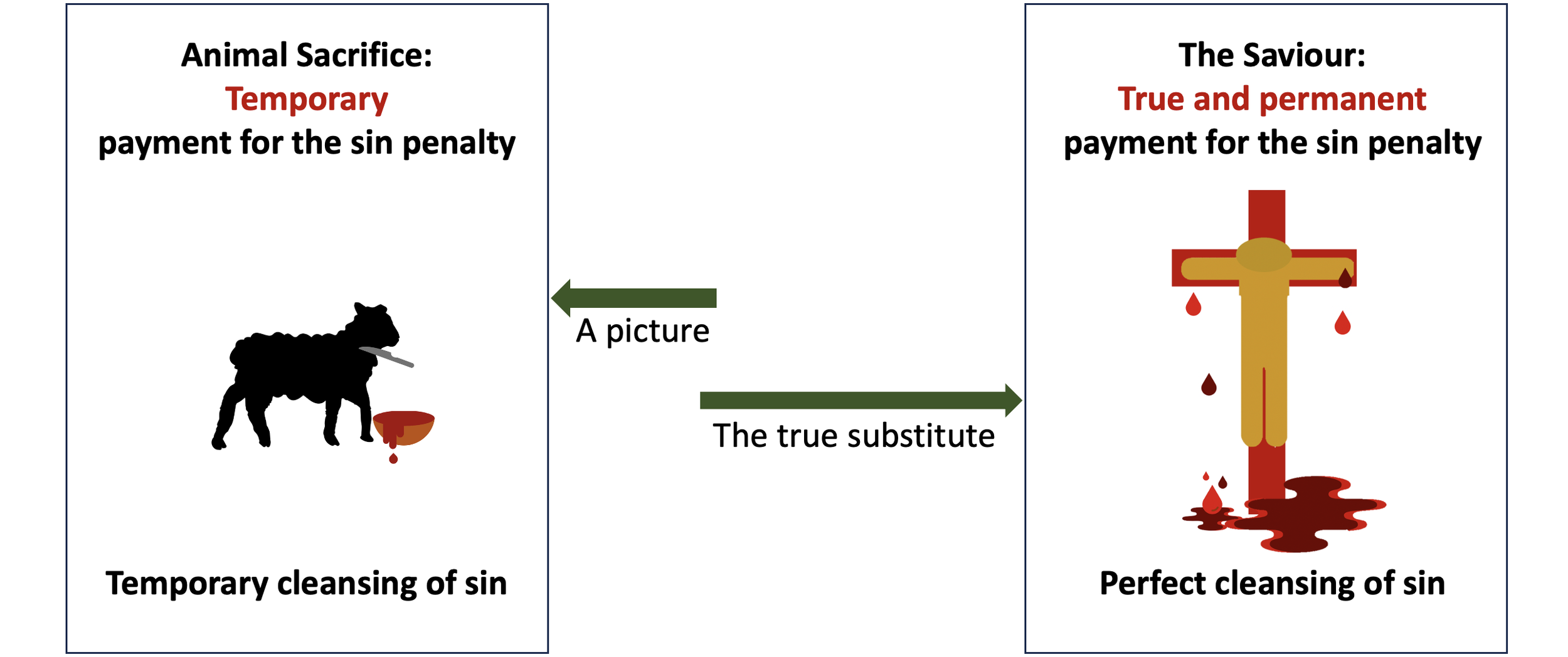
The lamb and the unleavened bread (bread without yeast) of the meal reminded Israel of how Yahweh saved all their firstborn sons and animals from death. God had accepted an innocent lamb dying in the place of the firstborn sons. The Passover meal not only looked back at what God did but also looked ahead to His future provision of the promised Saviour, who would come to be the sufficient substitute, dying in place of sinful mankind. In fact, the gospel of John refers back to Numbers 9:12, to the instruction not to break any bones of the sacrificial lamb.
John 19:36 records that the Saviour, the sacrificial Lamb of God, died on the cross without having his bones broken and this fulfilled the picture of the Passover lamb not having its bones broken. God was foreshadowing the work of the Saviour in the feast of the Passover so people would make the connection that Jesus is the real substitute.
And the bread without yeast reminded them of how God wanted them to break away from the old life of sin in order to live by God’s good ways every day.
But there was a practical problem. Some men approached Moses to say that they had recently handled a dead body. They were considered ceremonially unclean, meaning they could not participate in the Passover. What should they do?
Though Moses was the leader, he wasn’t hasty in his response. Instead, he went to speak to Yahweh at the Tabernacle, the portable tent of worship. In Numbers 7:89, the Bible recorded that Moses would regularly go to the Tabernacle to speak with Yahweh and God responded audibly to Moses’ questions. So now, Moses did the same and went to speak with Him. This showed how Moses as the leader did not handle problems based on his own ideas, but relied on Yahweh’s guidance. And so God gave him instructions.
God said to allow the men to celebrate the Passover one month later, when they would be considered ceremonially clean. God also allowed Israelites who were travelling during the Passover to celebrate it one month later. In this way, no Israelite would miss the opportunity to celebrate the Passover annually.
We see that while God was meticulous about how Israel should live, He was also kind, making provisions due to special circumstances. God also allowed foreigners who wanted to celebrate the Passover to participate but the requirement was that they first had to become Jewish as prescribed in the Mosaic Law. This meant that foreign men had to be circumcised because only circumcised males could take part in Passover.
But any Israelite who wilfully neglected the Passover would be cut off from the community. Israel’s national identity was shaped by remembering who Yahweh was to them. The Passover was so significant that Yahweh often identified Himself as “the God who rescued you from Egypt”. He wanted Israel to keep being grateful for who He was and what He had done for them.
While the Passover was about looking back in thankfulness, the next instructions were about looking ahead for God’s continued guidance.

Yahweh directed when and where the nation would go by His personal presence as represented by the column of cloud by day and the column of fire by night. His presence hovered over the most important room of the Tabernacle, the Holy of Holiness, the square-shaped closed room where the Ark of the Covenant was kept. Day or night, His presence was a constant reminder that He was with His people. If Yahweh wanted the nation to move to a different location, the cloud would move and the people packed up their belongings, broke camp and followed.
Christians can learn two lessons from today’s passage. First, we should regularly reflect and be thankful for all that God has done for us. He provided the Saviour for us, He took care of our sin problem and brought us into a relationship with Him.
Second, He offers His continued presence and guidance to us. It may seem nice to be able to see God’s presence physically in a column of cloud. But God did that to direct an entire nation who were living and moving together. Today, believers in Christ are all over the world, so instead of a visible presence, God the Holy Spirit resides in each of us. Just as Moses could go to God and ask for instructions, we also have direct access to God for His Spirit lives in us. We too, can ask God in prayer for guidance. And we have God’s Word, recorded for us to teach us how to live in ways that honour Him.
We worship a God who is ever present in our lives. Let us continually thank Him for what He has done and continues to do in our lives, and let us make it a habit to continually turn to Him and His Word for guidance.
The Devotional Journey: Bible Reading 70
The Nazirite vow: Yahweh allows non-Levites to temporarily dedicate themselves to Him
Read Numbers 6:1–27.
The tribe of Levi had the privilege of being the only tribe where priests and those who served at the Tabernacle (and later, the Temple) could come from. But Yahweh also made provisions so that any man or woman who were not Levites, could make a promise to dedicate themselves to serve Him for a designated period of time. This was entirely voluntary. Today’s reading addresses the process for a man, while Numbers 30 goes into more detail for women wanting to make a vow.
People who make such vows were called Nazirites. This is a Hebrew word that means to be “set apart” or “to dedicate”.
Yahweh said that people who wanted to be Nazirites had to, for the period of their vow:
not drink wine or have grape juice, raisins, grape seeds or even the skin of grapes, or any other alcoholic drink
not cut their hair or beard (for the men)
not go near any dead body (which was a picture of sin and death).

These people did not have to isolate themselves. They still lived as part of society but their attitudes and motives during this time of being set apart for God and was focused on serving God.
If a Nazirite happened to come upon a dead body during the period of their promise, God gave them instructions to stop the vow and how to later restart it again.
However, to restart, they would need to go through a cleansing ceremony. On the seventh day after being exposed to the dead body, they had to shave their head (signifying a restart), and on the eighth day, bring animal sacrifices. Yahweh was showing how serious He was about purity and how serious He took the person’s vow.

At the end of the time period of the vow, the Nazirite would have to undergo a ceremony to show that he completed his time of being set aside to serve Yahweh. This again involved sacrificing animals. The Nazirite would also shave his head and burn the cut hair with the fellowship offering. This signified the completion of the vow. After this, the Nazirite went back to normal life with no further Nazirite restrictions.
Yahweh also gave instructions for the priests, Aaron and his sons, to bless the nation of Israel. The first part of the blessing asked for God’s action which would then result in people’s benefit in the second part.
Numbers 6:24–26
[24] ‘May the LORD bless you
and protect you.
[25] May the LORD smile on you
and be gracious to you.
[26] May the LORD show you his favor
and give you his peace.’

Nazirite vows might seem very far removed from our daily lives today. However, here is a thought.
God never restricted those who wanted to dedicate themselves to Him from doing so. Even though God chose the Levites to serve Him, He didn’t prevent anyone else in Israel who loved Him and wanted to serve Him in a special way from doing so. To be clear, these people were not priests and would never become priests, but this special vow was something they could do to show their dedication to Yahweh. This was why God made provisions for the Nazirite vow. It was entirely voluntary. People could do this if they wanted to.
This type of vow belonged to national Israel and doesn’t apply to the church today. However, just thinking about why God gave national Israel this provision helps us see that God is happy to have people who want to dedicate themselves to serve Him in a special way be able to do so.
In our daily lives, we know that God wants us to be set apart for Him in the way we live. And He wants us to tell others about Him and the salvation He offers everyone.
Can people look at us and say that in our everyday lives, we live very differently from those who do not know Yahweh and do not worship Him? Can people see that our values are based on God’s Word rather than the world’s values?
Or do we feel drawn to dedicating ourselves to God in other ways? Some people choose to dedicate themselves to full time service for God in areas such as being a pastor, missionary or a worker in ministries that reflect God’s heart for people such as orphanages, schools, hospitals, crisis help, emergency relief, humanitarian aid, etc.
If so, seek more information and pray and ask for the Holy Spirit’s guidance in your life to direct you the way that God wants you to go.
May our everyday lives and our decisions in life reflect our love and devotion to Yahweh.
The Devotional Journey: Bible Reading 69
Yahweh organises the work of the Tabernacle for proper worship
Read Numbers 3:1–13, 40–51.
Recall that when the Israelites were still slaves of Pharaoh in Egypt, Yahweh sent 10 judgment plagues to get Pharaoh to release them. The tenth plague was the death of the firstborn males and animals in every household. This tenth plague would affect everyone, both the Egyptians and the Israelites.

However, God told Israel that He would spare the lives of their firstborns if they would sacrifice a lamb and paint the blood on the doorframes of their houses. Everyone in Israel did that and none of their firstborns died.

After that, Yahweh declared that in acknowledging what He did in sparing the lives of their firstborns, all firstborn males and animals would belong to Him. He had saved, or redeemed each one of them from death. So this meant that the firstborn males in each household would now serve God all their lives.
However, recall also that while Israel was at Mount Sinai, while Moses was talking to Yahweh on the mountain, the people created a golden calf idol to worship. When Moses came down the mountain and saw what they did, he commanded all who were loyal to God to take away the lives of those who worshiped the idol (Reading 57).
The Levites showed their loyalty to God by standing on Yahweh’s side and they executed God’s punishment on the idol worshippers.
Because of this, Yahweh rewarded the Levites by choosing their tribe to serve Him instead of all the firstborn males.

In addition, God later also said that one particular Levite family, Aaron (Moses’ brother) and his sons, would serve Him as priests. Aaron was to be the High Priest (or chief priest) and his four sons would serve under him as priests.
Alas, as we had read in an earlier event in Leviticus 10 (Reading 63), Nadab and Abihu were put to death by God for their rebellion against Him. This left Aaron’s other two sons, Eleazer and Ithamar to be the priests.
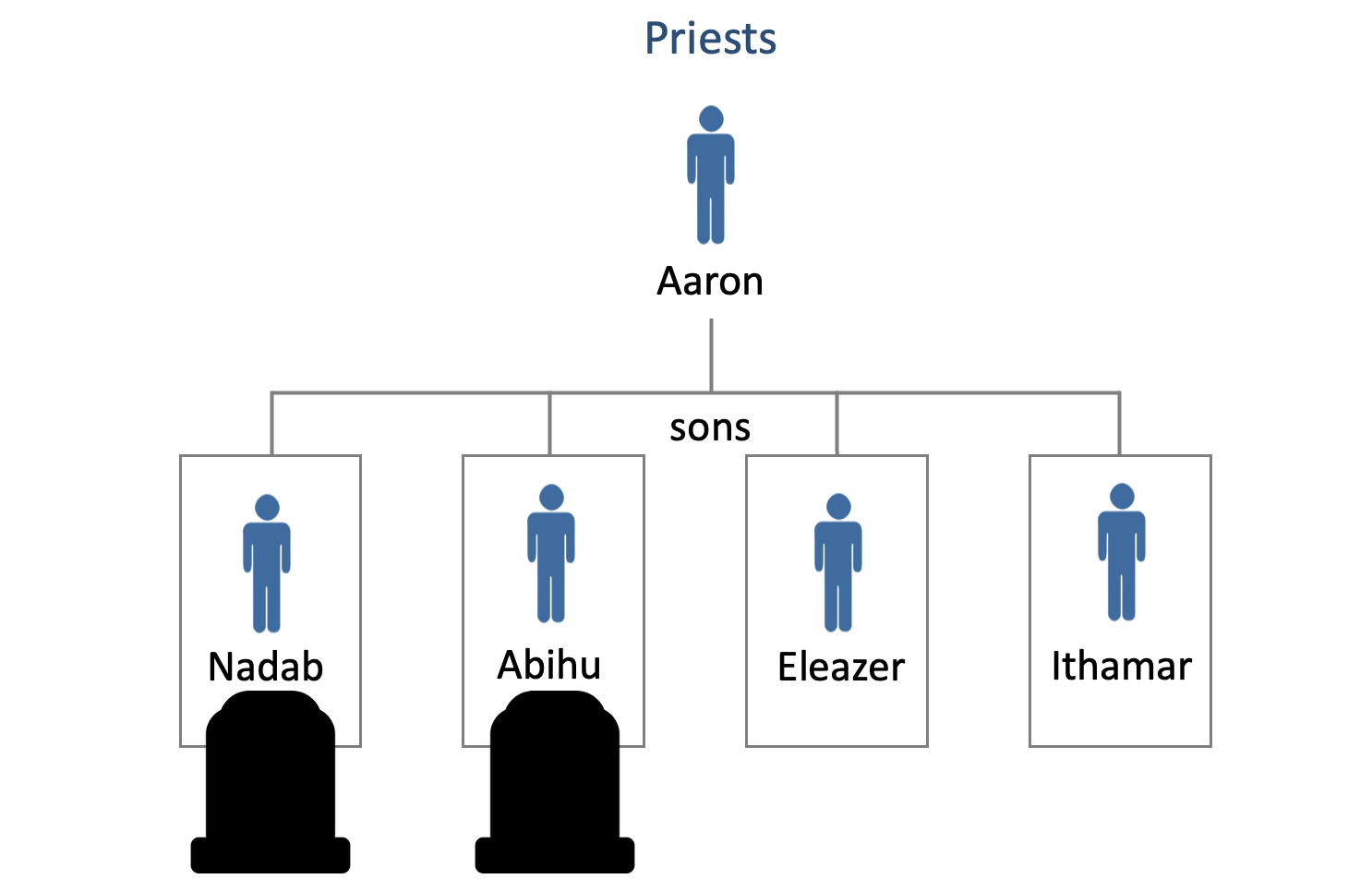
However, it was impossible for just these men to handle all of the work themselves. There was just too much to do. So God chose the entire tribe of Levi to be assistants to Aaron and his sons, by taking on certain responsibilities.
In today’s reading, God was giving instructions to the Levites. They were to do the work needed in the Tabernacle. But they had to be careful not to go too near to the parts of the Tabernacle that only priests were allowed to go.
But Yahweh wanted to ensure that the exchange of firstborn males with the Levites was an equal value exchange. He asked for a count of all the firstborn males in Israel. There were 22,273.
That meant that the tribe of Levi needed to have 22,273 males to replace the firstborns in serving God. But the tribe of Levi only had 22,000 men. There was a shortfall of 273 Levite men.

What could be done? The Levites just could not suddenly come up with 273 more men. So God said He would accept money in exchange for the shortfall. He set the redemption price at five shekels a man.
This meant a total of 273 x 5 =1,365 shekels.

In this way, Yahweh received the full value of all the firstborn males in Israel. He received it through the 22,000 Levite men and the 1,365 shekels.
Why was God doing all this? Why is it helpful for us to know all these details?
Yahweh was preparing the Israelites to engage with enemy nations and defeat them. In making all the arrangements of the people’s roles, detailing the way people were to worship Him and who was responsible for which job, God was showing the importance of organisation. It was important that the camp be orderly. If the camp were not orderly:
the people would experience nothing but chaos and confusion
they would not be worshipping God properly and
they would not be able to fight the enemy successfully.
As we ponder about the character of God, consider if we are like Him in this way.
Do we take the organisation of our lives seriously so we can accomplish the work He wants us to do? Or is our life filled with chaos and confusion? Ask God to help us appreciate His orderly character and also help us order our lives in a way that honours Him, reflects Him and helps us accomplish His will.
Think also about how God gives different jobs and roles to the people: Aaron had certain jobs, the priests had certain jobs, and the Levites had certain jobs. Working together by each doing their work well, the whole camp could run well.
As we think about the different people in our lives and the different roles that they play and jobs that they do, do we treasure and value each one of them for what they contribute? Or are we envious or jealous of their contribution? Let’s talk to God about our attitudes towards our family members, co-workers, project team mates, church friends and others. Let’s ask Him to help us have the right appreciation and attitude towards each of them.
The Devotional Journey: Bible Reading 68
Yahweh prepares national Israel’s military
Read Numbers 1:1–54.
In this Bible reading, we move on to the book of Numbers. This book contains many statistics and numbers, hence its name. The first section of Numbers records a census of the people by tribe. When we read these lists of names, they seem like just a list to us. But for that generation of Israel, it showed that Yahweh knew them all by name and each person was important to Him. They were His people and He was organising them before their entry into the Promised Land.
The rest of Numbers contains key events that happened over the course of the next 40 years of Israel’s national life. Though they were supposed to follow God’s leading and enter the Promised Land, the people responded in fear after hearing a report that it might be hard to take over the land. As a result, Yahweh disciplined them for their disbelief and distrust. God’s people had to learn how to follow Him and trust His power rather than giving in to their own fears and limitations.
In today’s reading, it was now one month after the Tabernacle had been erected in the wilderness of Sinai. Yahweh told Moses to count up all the men in Israel who were of military age, meaning 20 years and older. Moses was to count them up by tribe, clans and families. One man from each tribe was to help Moses with this job.
Here was what Moses found:

The Levites were not counted because they were exempted from military service. This was because Yahweh had chosen them to serve Him by taking care of the Tabernacle and all its furniture. They were the only ones responsible for erecting and dismantling it. God allowed no one else in Israel to do this. The important work of the Levites in assisting the priests was their contribution to the nation.
Yahweh also gave instructions for how the people would arrange their tents whenever Israel stopped to camp. The Tabernacle would be in the middle of the camp. The Levites would pitch their tents adjacent to the Tabernacle while all the other tribes would pitch their tents on the outer perimeter of the camp. In Numbers 2, God gave the details on where each tribe was to place their tents.

Notice how God was very intimately involved in the life of Israel. If God did not give clear and detailed instructions to Moses to give to the Israelites, they would not have known what to do, how to organise themselves, how to live. We see that God did not leave Israel alone to try to figure things out. He was very close to them. He helped them.
If we have ever wondered what Yahweh is like, we can see here that He is not a God who is far away, indifferent to His people and His creation. He is very interested and wants to be involved even in the daily lives of His people.
We can be sure that God loves us greatly and wants to be intimately involved in each of our lives as well. We need to feel free to talk to Him about even the details of our lives. He wants to be very close to us and wants us to be very close to Him. Let us therefore approach Him with confidence, knowing He wants to hear from us about even the smallest details of our lives.
Some people wonder why God wanted Israel to prepare for battle. We will see in later readings that the people living in the land that God gave to Israel were tremendously wicked. God is also a God of righteousness and justice. He will not let evil go on un-dealt with or unpunished.
This is important for us to remember. Sometimes, when we look around the world or around us and we see all kinds of wickedness and evil, we might be tempted to think that God can’t see or He doesn’t care. This is not true at all.
This is what one of the writers of the Psalms said:
Psalm 75:1–2
[1] We thank you, O God!
We give thanks because you are near.
People everywhere tell of your wonderful deeds.
[2] God says, “At the time I have planned,
I will bring justice against the wicked.
Let us trust that God will indeed judge the world with fairness and righteousness.
Today, as we pray, let us share intimate details of our life with God. Nothing in our lives is too small for Him.
Let us also thank Him that He is a God of justice and righteousness and that He will indeed judge the world to take away all wickedness in the future.
The Devotional Journey: Bible Tour Stop 6—The Wilderness Years
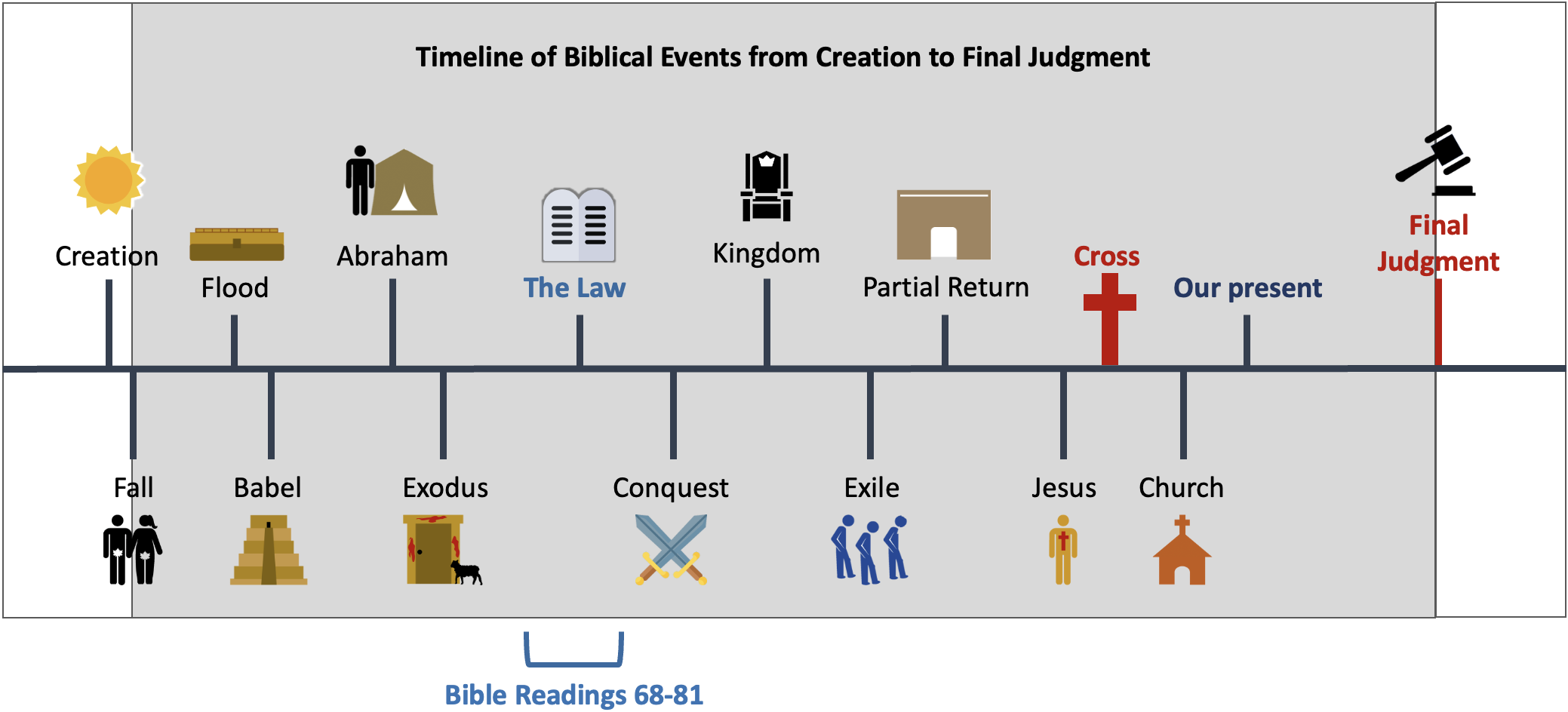
To recap where we are in the Bible tour, here is what we have seen in the Bible so far since the beginning.
We first read that Yahweh created the first man and woman, Adam and Eve, to have a personal relationship with Him. However, we saw that with the free will that God gave them, they chose to rebel against Him and instead, put their trust in the words of Satan.
From then on, every person was born separated from God. While some of Adam and Eve’s descendants chose to trust in Yahweh, most rebelled and continued to make God their enemy. Their wickedness became so bad, it exceeded the limits of God’s tolerance. So Yahweh sent a global Flood judgment. Only believing Noah and his family survived the flood. Everyone else who did not believe God, refused to enter the ark to be saved and so they died in the global floodwaters.
After the Flood, unfortunately, most of Noah’s descendants also chose to rebel against God. This would lead them to be eternally separated from God forever in the lake of fire. This was not good news for mankind.
So Yahweh started a different programme. He wanted to give all mankind an opportunity to know real history and truth and put their trust in Him to send a rescuer. But since mankind as a whole had already rejected Him, He chose to work through one man, Abram (later renamed Abraham).
Abraham trusted in Yahweh. And so God’s plan was that Abraham and his family would record His words and share it with the world. We saw how God kept Abraham’s family safe and grew them into a large nation while they were living in Egypt.
After living in Egypt for many years, the nation was enslaved by the leader of Egypt, the Pharaoh. While in great suffering, they called out to Yahweh for help. God sent Moses to lead the people out of Egypt. Through many miracles, the people saw how powerful Yahweh is.
Yahweh led them into the desert and at Mount Sinai, He established the nation of Israel as His people. He gave them their law, teaching them how they were to relate to Him, as well as how they were to relate to each other. His plan was for the nation of Israel to live by His good and righteous standards and in this way, be a model to the other nations around them of how it was to have a relationship with Yahweh, the Creator-God of the universe.
Earlier on, God had made Abraham three promises.
He would give Abraham land.
He would give Abraham many descendants.
Through Abraham and his family, God would bless the whole world.
In the next set of 14 readings, we will see what happens as Yahweh continues to prepare the nation to take possession of the promised land that He had given to Abraham, Isaac, Jacob and their descendants.
We will see Yahweh prepare Israel’s military and appoint the tribe of Levi to be the one to support the priests in their duties at the Tabernacle.
When the Israelites reach the southern border of the Promised Land, they send in twelve scouts to explore the land. But alas, ten of the scouts give a bad report and the people refuse to enter the land as Yahweh had instructed. This rebellion against God is punished. Yahweh tells the people they will be wandering in the wilderness for 40 years until the rebellious generation dies.
This doesn’t make them repent and they rebel again, this time against God’s choice of leaders. Yahweh disciplines them once more.
Then as the first generation dies off and the 40 years come to an end, the children, now grown, proceed towards the Promised Land. Yahweh leads Israel to successful battles against enemy nations. One nation, Moab, fearful of military action, decides to take spiritual action instead. The king of Moab hires a wicked prophet named Balaam to curse Israel.
The Devotional Journey: Bible Reading 67
Yahweh teaches the people how He wants them to show care
Read Leviticus 25:1–22.
Yahweh created the world in six ordinary days and rested on the seventh. He told mankind that they should reflect Him and also work six days and rest on the seventh day. The seventh day was for their rest, refreshment and restoration.

Similarly, God told the Israelites that they were to give their land rest on the seventh year. They could plant and reap for six years. But on the seventh year, they had to let the land rest and rejuvenate. They were not to abuse the land by constantly working it. In addition, during that year of rest (known as the Sabbath year), whatever the land produced naturally could be eaten by anyone: the landowner, neighbour, stranger and animal.

Even though Yahweh had practical reasons for calling for rest for people, animals and land, He was also teaching a spiritual lesson. He was the One who was the real provider of all.
Yahweh provided for them through their work (such as during the six years of regular farming). But He was also the One who provided for them even when they rested. In fact, He was always providing for them by sending rain and sunshine for their crops.
However, God knew that some people would be worried about what they would eat during the seventh year if they did not plant and harvest. God assured them that if they trusted Him and obeyed His instructions, on the sixth year, He would give them so much harvest that their food would be enough to last three years! This meant they didn’t need to fear going hungry on year seven, the year of rest!

Aside from giving instructions for this special Sabbath year, God also told them about another special year: the Year of Jubilee.
Every 50th year, after seven sets of seven years (49 years), they were to declare the Year of Jubilee.

What was this about?
When Yahweh first distributed the Promised Land to the people of Israel, each family had a permanent inheritance of land. Their God-given land would always remain with the family so they could grow crops and animals, make money from the produce, take care of their needs and pass down the land to the next generation. Each generation would have the means to make a living.
However, for various reasons, a family might become very poor. At that point, they would have the option of renting out their land for a period of time. The one who rented it could farm on it and reap its harvests. However, God’s law stated that the land could never be sold to the renter.
On the 50th year, the renter had to return the land to the landowner.
In this way, Yahweh protected family inheritances for all His people.
God gave all these instructions because He wanted His people to live in such a way that they would reflect His good character. Like Him, they would show concern and love to creation and to each other.
In thinking about today’s reading, here are three things we can reflect on.
Because Yahweh is a loving God who is deeply concerned for all His creation, the instructions He gave were for His creation to thrive. Think about how detailed and careful He is even with the land. As people made in His image, how much more concerned do we think He is of us? Do you truly understand how much He loves you?
God provided for the Israelites whether they were working or resting. In our lives, do we also see God as our ultimate provider? If we rest one day a week, are we afraid that He would not be able to provide for us? Who do we think is our ultimate provider? Let us pray and ask God to examine the attitude of our hearts towards Him, especially regarding resting from work.
God didn’t want the Israelites to take advantage of each other. In thinking of our own lives, what is our attitude towards others? Do we care for others? Are we careful not to take advantage of them? Pray and ask God to reveal areas in our lives or people in our lives we might need to talk to Him about.
The Devotional Journey: Bible Reading 66
Yahweh’s law is a reflection of His all-righteous character
Read Psalm 119:97–120.
Since we have been looking closely at the laws that Yahweh gave Israel, in today’s reading, we hop over to Psalm 119 to examine the attitude of someone who loves God’s law and loves to obey it.
Psalm 119 is the longest psalm in the Bible. It was written much later than the events of the Exodus and it is filled with appreciation for Yahweh’s laws and praises God’s instructions as being of greater value than any human wisdom. Each of its twenty-two stanzas begins with a letter of the Hebrew alphabet. We could think of the psalm as a love song to God’s law for Israel.
In verses 97–104, the psalmist says he loves studying Yahweh’s instructions and he thinks about them all day long. He recognises that God has revealed Himself in Scripture and thinking carefully, or meditating on His Word, gives deep insight about God’s character and about life. One can get more insight than one’s teachers!

And keeping Yahweh's commandments is the best way to live. God’s laws demonstrate His wisdom and living by His instructions makes one wiser than a tribal elder.
When we learn what righteousness is like through the study of Yahweh’s law, we will want to avoid walking down evil paths, that is, behaving in evil ways. The path of evil is a false way of life that leads to misery and separation from an all-loving and all-righteous God.
The psalmist ends this stanza by declaring that God’s words are sweeter than honey for those who are eager to obey.

Then in the next stanza of verses 105–112, the psalmist starts by declaring that God’s Word is a lamp to guide one’s feet and a light for one’s path. This is a picture of how Scripture gives us direction and guidance in all circumstances of life. We have already seen how Yahweh's laws address so many areas of life and they are based on His all-good nature. Living by God’s Word guides a believer down right paths.
This doesn’t mean the believer will have a problem-free life. By nature, the enemies of God go after the people of God. But the believer who clings to God and obeys His laws will enjoy close fellowship with Yahweh and will still experience the joy of a close relationship even if the circumstances of life turn hard. Having tasted the happiness of being close to God in the midst of trials, such a believer will be determined to keep following God.

This is in contrast to people of divided loyalties. In the next stanza (verses 113–120), people who are double-minded often choose to obey their pride and sinful desires. Such people end up not obeying God’s Word and they lose that close fellowship with Yahweh. They stray away from God to their own harm. But the loyal believer continues to love God’s instructions and God is their shield.
“Lord, sustain me as you promised, that I may live! Do not let my hope be crushed.” (Verse 116.) We see once more that the loyal believer is not free from suffering or trials, but God will rescue and sustain those who delight in Him.
Then in the closing words of this stanza, the psalmist writes in verse 119: “You skim off the wicked of the earth like scum; no wonder I love to obey your laws!” Here, the psalmist is looking ahead into the far future where Yahweh will judge evil permanently. The believer who has studied God’s Word carefully knows where Yahweh is taking history. He knows how world history will end with Yahweh’s complete victory over evil. So knowing what happens in the future provides the motivation to keep going on in life, even when circumstances are hard. It motivates one to keep obeying God.

Slowly read through today’s reading once more. Reflect on the emotions of the psalmist.
Are you also as excited to study God’s Word?
Does learning about Yahweh's character fill you with joy?
Does it motivate you to obey His Word and live in the way He instructs?
If so, thank God for the gift of His Word.
If you’re feeling less than enthusiastic about God’s Word:
Ask the Holy Spirit to give you insight when you next read Scripture.
Ask the Holy Spirit to rekindle the excitement of learning about God and where He is directing history.
Ask the Holy Spirit to move you into deeper fellowship with God through an increased understanding of the Word He has given us.
The Devotional Journey: Bible Reading 65
Yahweh teaches the people how to live according to His righteous standards
Read Leviticus 19:1–37.
In today’s reading, Yahweh gave Moses a detailed list of instructions for how His people should conduct themselves in their everyday lives. God is all-righteous, all-just and all-loving. These characteristics set Him apart from everyone else. This is what being holy means, to be set apart from everything else.
Yahweh instructed His people to live like Him even though He knew that Israel was sinful. In following the nation’s history so far, we have already seen how sinful they could be. They were stubborn, disobedient, idol-worshipping, constantly complaining, and very often ungrateful. But God still expected better of them.
They were to be His representatives and so He didn’t want them to live in such sinful ways. He called them to change their behaviour and model their daily lives after Him. He set the moral standards for their daily lives by giving them His regulations.
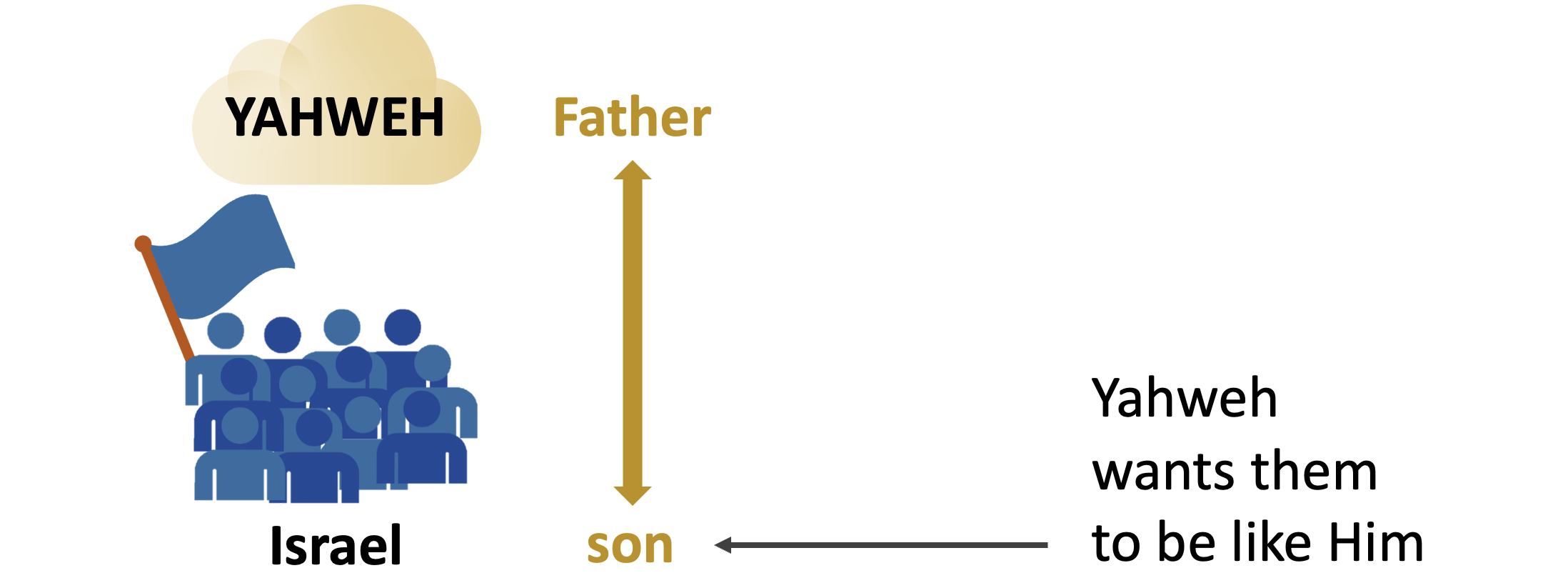
In today’s passage, we can see God give Israel regulations regarding many areas of life:
how to have love and respect in personal relationships
how to be distinct in the way they practised agriculture and animal husbandry
how to be ethical in business and personal dealings
how to take care of the poor and the foreigners and more.
There were even warnings against attempting to seek help from other sources like fortune-telling. Living in the way He prescribed would transform their lives and their society. They would stand apart from all the nations around them.
Let’s look into one example: taking care of the poor and the foreigners who have chosen to live with Israel. Yahweh knew there would be poor people for various reasons. So He instructed the people that during the harvest, they were not to harvest the edges of their grain fields or pick up dropped grain. This meant that there would be some grain left in the fields. Similarly, He instructed the people not to harvest every last bunch of grapes from their vineyards. They were to leave some of the fruit behind. This was to ensure that the poor could go into their fields and have something to eat.
Both the poor Israelites and foreigners living within Israel were entitled to take these parts of the harvest, which were known as the gleanings. These instructions, along with other similar ones, showed Yahweh’s heart for all the people. God was instructing the people to care for everyone in their society.
Yahweh’s regulations were meticulous. If the people understood God’s heart in giving them these rules, they would know that God wasn’t being legalistic, but rather, he was detailed in how far He wanted them to really take care of each other, respect each other and show honour to one another.
The key principle of God’s laws regarding living together is in verse 18: “Love your neighbour as yourself.”
Though church-age believers like us are not bound by the laws that God gave to Israel, we worship the same God. So we can take note of the principles in the laws that Yahweh gave to Israel.
In the New Testament gospel of Matthew, an expert in religious law asked Jesus the following question.
Matthew 22:36–40
[36] “Teacher, which is the most important commandment in the law of Moses?”
[37] Jesus replied, “‘You must love the Lord your God with all your heart, all your soul, and all your mind.’ [38] This is the first and greatest commandment.
[39] A second is equally important: ‘Love your neighbor as yourself.’ [40] The entire law and all the demands of the prophets are based on these two commandments.”
Jesus quoted from today’s reading: “Love your neighbour as yourself.” He said loving God (through our thoughts, words and actions) and loving others as we would love ourselves were both equally important. Why? Because God is all-righteous, all-just and all-loving. And when His people model themselves after His characteristics, they would also love righteousness, justice and each other. God made mankind to be His representatives, to reflect who He is. So if we focus on these two loves, we will be living in a God-honouring way.
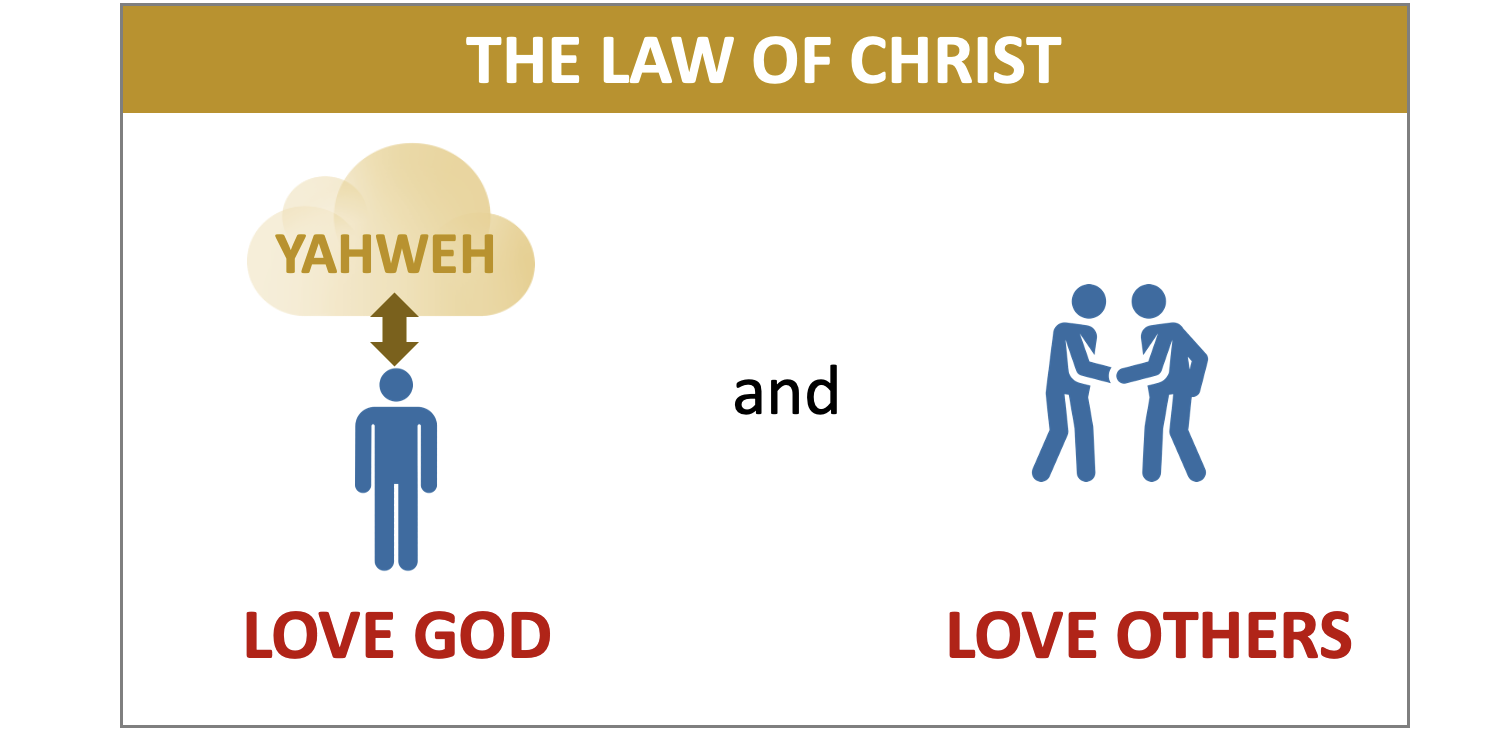
As we reflect on our own lives, think about how we are showing love and care for the people in our lives, from loved ones, family members, to friends, neighbours, co-workers and others.
Pray and ask the Holy Spirit to bring to mind people and areas of our lives where we can improve in the way we relate to them.
God may be pointing to some relationships that are more difficult to change. For these tough relationships, pray for courage, wisdom and the willingness to take the first step to “love your neighbour as yourself.”
The Devotional Journey: Bible Reading 64
Yahweh teaches more about how He forgives using the Day of Atonement
Read Leviticus 16:1–34.
In today’s reading, Yahweh gives instructions for a special annual sacrifice that is performed by the high priest on behalf of the nation of Israel.
In Hebrew, it came to be known as Yom Kippur, which in English is called the Day of Atonement. This was the second of three appointed times or festivals in the autumn (part of a total of seven annual festivals that Yahweh appointed for Israel).

Over the course of the year, Israel would have accumulated sins that God said polluted the nation and the Tabernacle. So God said the Day of Atonement was a day to purify or cleanse the nation from a year’s worth of sin.
Through a series of rituals, the high priest would purify the Most Holy Place of the Tabernacle (the closed-off room where the ark of the covenant was kept and where God’s presence dwelled). From there, the purification would spread throughout the Tabernacle and then to the entire camp of Israel.

The high priest started the process by first making a bull sacrifice to purify himself and his family. Then he took some of the bull’s blood and sprinkled it on the cover of the ark of the covenant. The lifeblood of the substitute bull cleansed the ark.
Then he selected two flawless goats and casting special lots (that is, a system of random selection), he would select one goat as the sin sacrifice and the other to be the scapegoat. (This word scapegoat was made of the words “escape goat” and this English word was invented as the translation of the Hebrew word.)

The goat for the sin sacrifice was killed and some of its blood sprinkled on the cover of the ark of the covenant. And some of the blood of the bull and the sin sacrifice goat was also applied to the altar of the Tabernacle (this was where the sacrificed animals were burnt). All the blood would purify the Tabernacle from the sins of Israel.
Next, the high priest, representing the nation, would lay both hands on the scapegoat’s head. This signified identification, that the scapegoat would take on the sins of the people. The high priest would confess the sins of the people before Yahweh and symbolically, the scapegoat would take on the sins of Israel.
Then Yahweh commanded that an appointed person lead the scapegoat away. As the carrier of the people’s sins, the scapegoat was taken out of the camp and led far, far away from Israel. The scapegoat was released into the wilderness and would never be seen again. It was a powerful visual reminder of what Yahweh would do with the people’s sins, once a sin sacrifice was made. God would not count the people’s sins against them any longer. He had removed their sins from them. God said these annual sacrifices would purify or cleanse Israel of its unintentional sins of the past year. In this way, Yahweh would then remain with Israel for another year.
This annual ceremony on the Day of Atonement also pictured for the people the cleansing work of the coming, promised Messiah. This was especially seen with the two sacrificial goats. On one hand, the Messiah would die and pay for mankind’s sin. His death would cleanse people from their sins, allowing God to declare them righteous.
On the other hand, the scapegoat that was led far, far away and abandoned into the wilderness demonstrated that Messiah’s sacrifice would truly remove the people’s sins and God would not count it against them any longer because they have been paid for. What a wonderful picture of the Messiah’s work!
Let’s be thankful again for God’s initiative in providing the Messiah, or the Saviour, to take away our sins by personally paying for our death penalty. Now that we are forgiven through Christ, we should not feel guilty about past sins and think that God still holds them against us. Like the scapegoat, He has removed our sin far, far away from us.
In Psalm 103, King David makes this observation.
Psalm 103:7–12
[7] He revealed his character to Moses
and his deeds to the people of Israel.
[8] The LORD is compassionate and merciful,
slow to get angry and filled with unfailing love.
[9] He will not constantly accuse us,
nor remain angry forever.
[10] He does not punish us for all our sins;
he does not deal harshly with us, as we deserve.
[11] For his unfailing love toward those who fear him
is as great as the height of the heavens above the earth.
[12] He has removed our sins as far from us
as the east is from the west.
David recognised that when God forgives, our sins are removed far from us, as far as the east is from the west.
But God recognises that even as believers, we will still sin. But we can go to Him immediately to confess our sins and He will forgive us.
1 John 1:9
But if we confess our sins to him, he is faithful and just to forgive us our sins and to cleanse us from all wickedness.
However, we must not take God for granted. We must not think that we can be casual about sin. When we accumulate sin and don’t confess them to God, our fellowship with Him becomes strained. And when it becomes strained over time, we shy away from Him and this makes it easier for us to sin and make things even worse.
Let’s not do that. Let’s be ready to confess sin and restore our fellowship with Him.
Examine your past week and month. Have you done anything that drove you away from God? If so, confess it now and He will forgive and restore your fellowship with Him.