
The Devotional Journey: Bible Reading 78
Yahweh punishes the people with poisonous snakes
Read Numbers 21:1–35.
The Israelites were now on the march towards the Promised Land. They departed from Mount Hor where Aaron was buried (Numbers 20:23–24) towards the plains of Moab (Numbers 22:1). This chapter contains three early battles that showed Yahweh’s protective guidance of the nation despite all their faults and failures.
God directed Israel southeast skirting past Edom, then northwards. Though the general direction is clear, the exact route is not known with precision because several locations have been hard to identify.
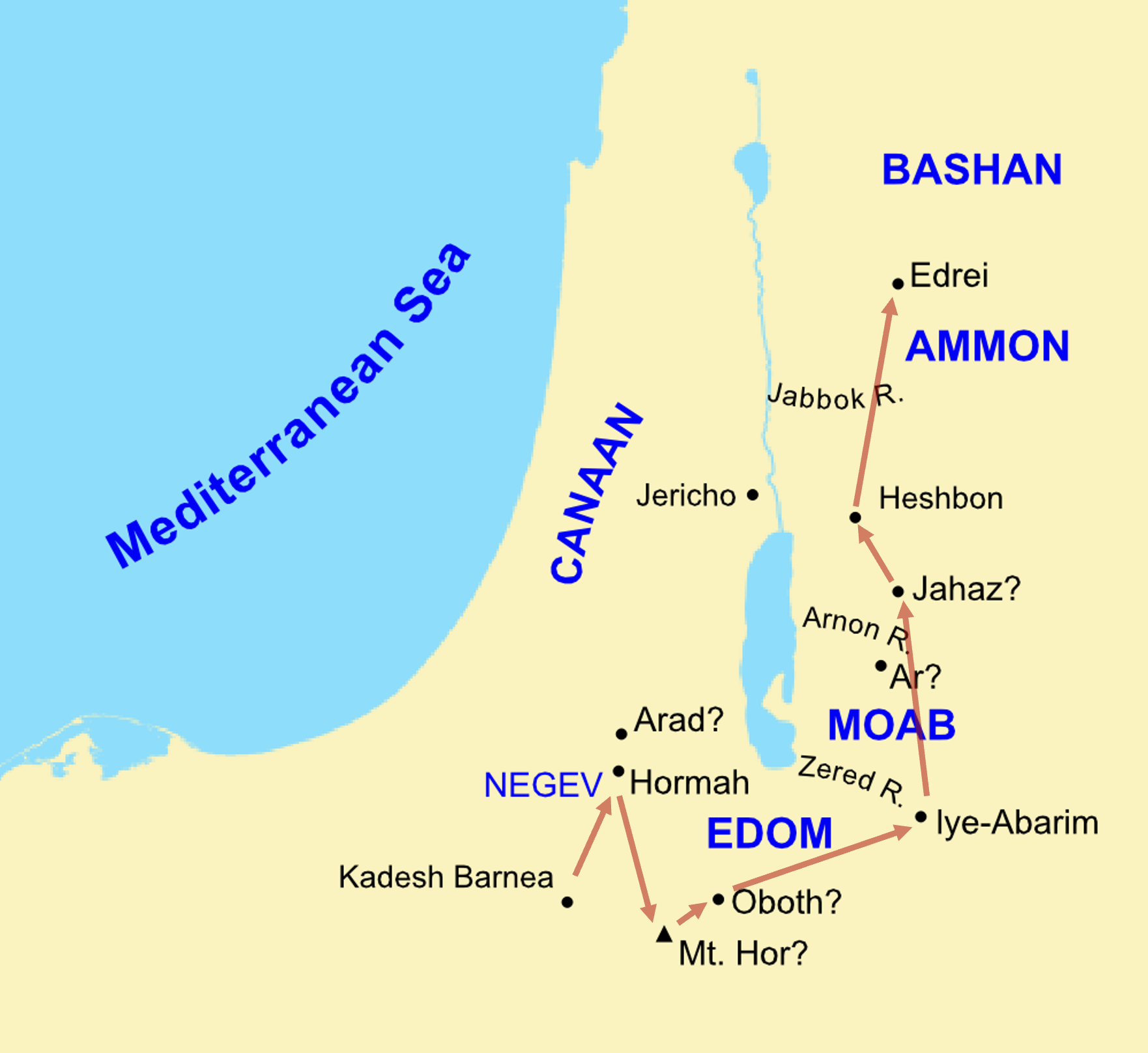
The first battle was against the king of Arad who came out against Israel, but Yahweh enabled them to soundly defeat him (verses 1–3). Israel had vowed to completely destroy Arad and his towns. “Completely destroy” in Hebrew meant to devote something completely to Yahweh, in this case, by wiping out all signs of evil. The Canaanite culture was totally wicked, especially their religious practices, and Yahweh was using Israel as His instrument of punishment (Genesis 15:16). This battle was in complete contrast to the battle 38 years ago at Kadesh-Barnea, when Israel went to battle without God’s command (Reading 74).
Next, they faced Sihon of the Amorites. Israel initially sought permission to pass through his territory but King Sihon refused and came out with his troops. Israel fought them at Jahaz and Yahweh enabled them to win. The Israelites sang a taunt song that the Amorites had originally sung (verses 27–30) when they first drove out the resident Moabites.
Yahweh had told Israel not to invade Ammon (Deuteronomy 2:19), Edom or Moab (Deuteronomy 2:4–9) because these nations were distant relatives. The Edomites were descendants of Esau (Genesis 25:30), while the Ammonites and Moabites were descendants of Lot (Genesis19:36–38). And so Israel moved northwards.
The third battle was with Og of Bashan. The victory against Og was significant as his people were more powerful than Israel. Og himself was giant-sized. Deuteronomy 3:11 mentions that Og had an iron bed measuring 4m by 1.8m (14 ft by 6 ft)! But once more, Yahweh gave victory to His people.
These were training battles, helping Israel see how Yahweh would win all battles for them when they obeyed.
It’s one thing to have victory in battle and quite something else to have long-range, daily endurance. While on the long march through the wilderness going around Edom’s territory, the people again grew impatient and began complaining.
Their anger grew into harsh words against God and Moses. In their attitudes and words, they were testing Yahweh, which is never wise to do. The people forgot Yahweh’s power and promises. They forgot that for 38 years, He had miraculously supplied water and bread from heaven. They had said the manna tasted like honeyed wafers (Reading 47). Now they were sick of it. They were taking God’s provision for granted.
In the past, Yahweh warned them before punishing them. This time, He sent venomous snakes without warning. (Some translations refer to them as “fiery” snakes, perhaps in reference to their colour or how their poison burnt.)
The people admitted to Moses they had sinned against Yahweh. This was actually an improvement in their attitude, as previously, Moses had to take the initiative to mediate for them. But now they confessed their sin.
Instead of simply healing them, Yahweh instructed Moses to make a bronze serpent and mount it on a pole. Anyone who was poisoned had to simply look at the bronze snake and he or she would be healed.
Jesus made reference to this historical event in the gospel of John.
John 3:14–15
[14] And as Moses lifted up the bronze snake on a pole in the wilderness, so the Son of Man must be lifted up, [15] so that everyone who believes in him will have eternal life.
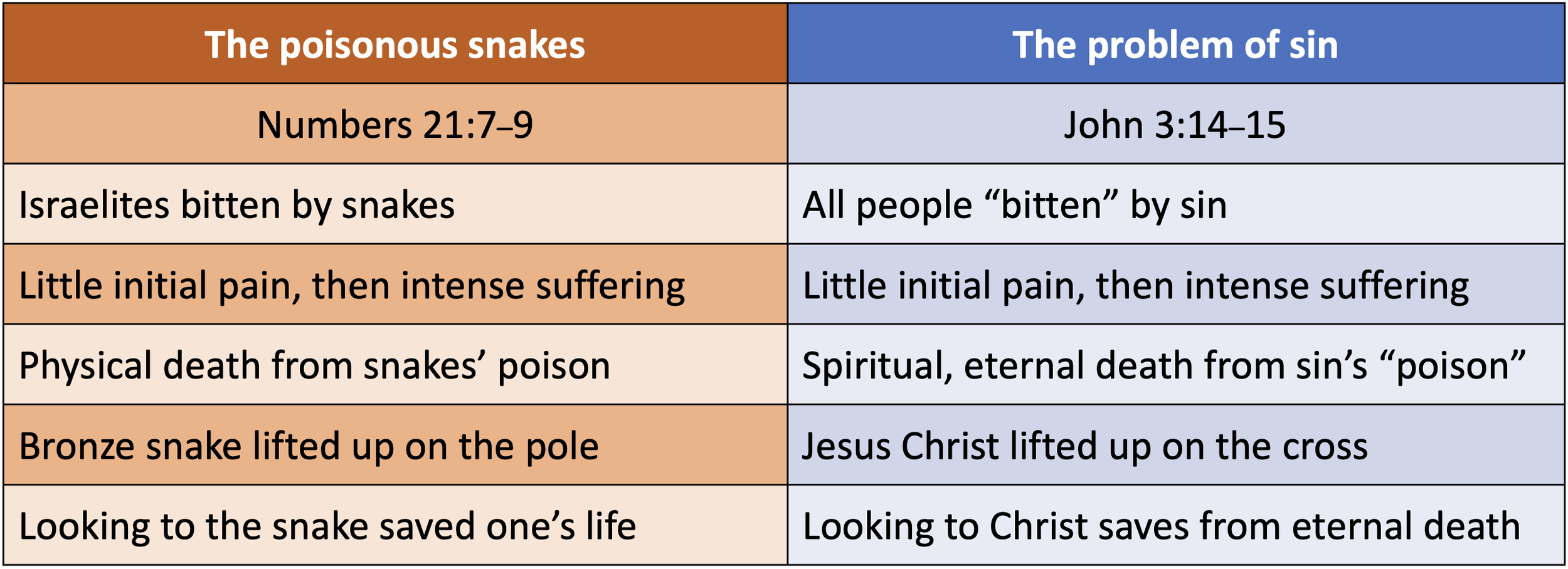
The comparison between lifting up the bronze snake in Moses’ day and lifting up Jesus on a Roman cross helps us better understand God’s grace in salvation.
All people are infected by sin and face eternal death. All people are unable to save themselves. But if they look in faith to Christ and His work on the cross, He will save them and give them eternal life. Just as the poisoned Israelites could do nothing to save themselves from physical death, all people can do nothing to save themselves from eternal death. But looking to Christ, or trusting Christ to save them, is the solution.
Jesus also mentioned the manna.
John 6:27–35
[27] But don’t be so concerned about perishable things like food. Spend your energy seeking the eternal life that the Son of Man can give you. For God the Father has given me the seal of his approval.”
[28] They replied, “We want to perform God’s works, too. What should we do?”
[29] Jesus told them, “This is the only work God wants from you: Believe in the one he has sent.”
[30] They answered, “Show us a miraculous sign if you want us to believe in you. What can you do? [31] After all, our ancestors ate manna while they journeyed through the wilderness! The Scriptures say, ‘Moses gave them bread from heaven to eat.’”
[32] Jesus said, “I tell you the truth, Moses didn’t give you bread from heaven. My Father did. And now he offers you the true bread from heaven. [33] The true bread of God is the one who comes down from heaven and gives life to the world.”
[34] “Sir,” they said, “give us that bread every day.”
[35] Jesus replied, “I am the bread of life. Whoever comes to me will never be hungry again. Whoever believes in me will never be thirsty.
The bread that the Israelites received was miraculous, but it only sustained them for a day. They needed more the next day.
The true bread of life—Jesus—sustains all believers for eternity. Whoever puts trust in Jesus will have eternal life.
Here are some reflections for us.
The Israelites, though fed by the miraculous bread, grew to despise it. How about us? Jesus says He is the true bread from heaven. And He feeds us daily through His Word. Do we look forward to our daily bread or have we grown bored with it, or worse, grown tired of it and want something else? What else can possibly sustain us and grow us into spiritual maturity? (Hint: nothing!) What is our attitude towards Jesus and His Word? Talk to God about it.
Though the Israelites were not yet spiritually mature and frequently disobedient, God was gracious to lead them to early victories. He had assured Moses that Israel would conquer its enemies because He would go with them (Exodus 23:23; Reading 54). God also wants to give us victory over our enemies (which aren’t usually armed soldiers but problems related to sin). But we must first believe that He can help us. And we must take the steps He shows us. If we refuse to move forward in faith, we show distrust and won’t be able to conquer our sin issues.
Moses didn’t hide the bronze snake but made it visible to all who were willing to look at it and be healed. The uplifted snake was the only cure. In the same way, Jesus Christ is the only cure for mankind’s sin problem. Are we like Moses, lifting up Jesus so that others have an opportunity to look to Him in faith and live? Every person is personally responsible for the choice to look to Christ or not, but are we helping others know there is a solution to life’s most pressing problem?